
Why you shouldn't trust early Metacritic scores

Me
Wednesday, March 16, 2011
EDITOR'S NOTEfrom Brett Bates

Having played some of the abysmal Homefront, I can tell you it's very important to wait to check the Metacritic average until after a game's release.

Metacritic

I need to begin this week's column with a little inside baseball. Sometimes public relations or marketing firms for video-game publishers impose embargoes on the video-game press, before which no information about a game can be published. Screenshots, movies, press releases, or reviews can all be embargoed, and it’s in the best interests of an outlet to respect the embargo and protect their relationship with the publisher.

However, sometimes outlets are given permission to ignore embargoes when it comes to publishing their reviews. 

The usual narrative goes like this: A PR or marketing person representing a publisher will call up a journalism outlet and say something along the lines of “Hey, we were just checking in on how your review of 'Super AAA Title X' was going…are you liking the game?” The outlet then has two choices: They can either play ball or politely decline. If they play ball and note that they're thinking about giving the game a good score, the publisher may allow them to break embargo and publish the review early.

Why would marketing want that? Simple: They're hoping for a skewed Metacritic score before a game's release.


I spoke to Justin McElroy, the reviews editor at Joystiq, about this phenomenon:

While I've never been directly offered early publication for a high-scoring review, I've been asked about my score by publishers or PR that then let a high scoring review (or several high-scoring reviews) run ahead of the agreed-upon embargo time.

We don't reveal our scores to PR ahead of time for a couple of reasons. First is that we'd be complicit in creating an artifice of quality, which is exactly the sort of thing that editorial and news outlets should, in my opinion, be endeavoring to dismantle.

Second, and I think more harmfully, the practice of allowing high scoring reviews to break embargo puts enormous pressure on smaller sites to inflate scores to net some of the increased traffic an early or exclusive review provides.

Even if the publishing of pre-embargo reviews is not something deliberately orchestrated by PR and marketing departments, failing to be aware of embargo dates or choosing to publish early can have negative consequences on gamers' ability to use Metascores to wisely guide their purchasing decisions.

To illustrate this point, I would like to look at the Metascore for Homefront pre- and post-embargo.

Here’s a screenshot of the Metacritic Xbox 360 Homefront score on Saturday, March 12, or three days before the official review embargo of March 15:

Homefront Metacritic Xbox 360 Page Pre Embargo score

Metascores influence game sales, and that warrants some watchdog analysis of how and when Metacritic lists reviews. To wit, what did Homefront’s score look like on March 15?
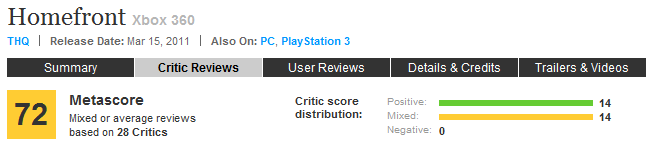
Homefront Metacritic Xbox 360 Score March 15 2011

A 16-point drop is nothing to sneeze at. Once the embargo was lifted, the Metascore more accurately reflected critics' appraisal of the title. This information is much more useful to consumers deciding whether or not to purchase the game.

I contacted the outlets who published pre-embargo Homefront reviews. Two got back to me. One was unwilling to go on the record about the circumstances under which their review was published, and the other was unwilling to discuss the nature of their relationship with publisher THQ at all.

I'm more inclined to believe that pre-embargo reviews are published early with the permission of a publisher, rather than as an act of defiance. I'm also inclined to believe that publishers simply take advantage of reviews which are going to be positive regardless of when they would be published, and then allow them to publish early once the publisher is aware that the review is positive.

The moral of this story is that if Metascores matter to you, wait after a game is released to view the score for the first time. Be an educated consumer: Understand that there are forces at work trying to manipulate these Metascores, and that they're are not accurate until the majority of all the reviewers' scores have been reported and factored in.


Dennis Scimeca is a freelance writer from Boston, MA. He has written for Gamasutra, GamePro, The Escapist, G4TV.com, Joystick Division, and @Gamer magazine, and maintains a blog at punchingsnakes.com. Follow him on Twitter: @DennisScimeca. First Person is his weekly column on Bitmob.

 
Problem? Report this post
BITMOB'S SPONSOR
Adsense-placeholder
Comments (21)
Alexemmy
March 15, 2011

I really hope John Davison helps make some changes to fix things like this from happening now that he's at Metacritic. It might be a long time until the overall public is so educated about practices like this, and it really needs to stop as soon as possible.

Channel5
March 15, 2011

I'm starting to read reviews at night to help me fall asleep. Came across IGN's review of Homefront and that was all I needed to know that I wasn't going to rent it. I used to swear by Gamespot checking out every game that got an 8.0 or higher, but not so much anymore.

Default_picture
March 15, 2011

I think another interesting element is viral marketing. I don't really approve of it because they're concentrating on promoting a game by abusing the score system, as opposed to making an actual good game.

Good timing actually, because one of Biowares employees have been caught red-handed giving DA2 a 10/10 to counteract the negative community reception it is getting. There's nothing wrong with being proud of your game and promoting it, but assuming another internet identity is misleading because as a developer you're obviously going to be biased.

Mitch_jul31
March 15, 2011

You've got a serious logical leap in your implications here, Dennis. You begin by pointing out high scores, suggesting they're only high because outlets wanted the traffic -- certainly possible, but you've got no justification here -- then simply showing an image of other reviewers with lower scores. Granted, I know where you're coming from: Larger outlets think less of the game, which is why thier reviews were restricted to embargo. However, presenting the images one after another and simply implying some sort of corruption. Furthermore, you admit to having no experience with this sort of thing when you mention you can't provide sources. These are heavy claims for hearsay.

Me
March 15, 2011

I believe my edits may have addressed some of your concerns, Mitch?

No, I don't think that outlets score high in order to get permission to publish pre-embargo and garner early Metacritic traffic - but you know as well as I do that publishers will sometimes grant permission to publish pre-embargo if they know that an outlet is going to grant a high score. You've been privy to some of the same conversations I have where this has been discussed.

I make no criticism of this practice, because games journalism is a business. Advertising rates are set by web traffic. However, this column is about arming readers with knowledge. Not everyone realizes that these practices take place. Hell, many readers might not even realize that review embargoes even exist! By arming readers with knowledge, in this case the knowledge that a pre-release Metascore could be very different than a post-release Metascore, we enable them to make better purchasing decisions.

And for the record, this cuts both ways. I don't know why an outlet would choose to break embargo and publish early with a LOW score, which could threaten that outlet's relationship with a publisher and likely cost them their review software in the future, but let's say they did. Gamers should take no more notice of that pre-embargo BAD score than they should take notice of a pre-embargo GOOD score.

Gamers should always wait a few days for things to even out and settle if they must use Metascore as a metric by which to gauge their potential purchase of a title.

Default_picture
March 16, 2011

Very unprofessional article full of assumption, un-factual information and zero evidence to substantiate any of the claim/assumptions. You have implied  that the sites you mention have either broken an embargo date or that they have danced a dance as you call it to give higher scores which has enabled  them to gain permission to publish early reviews.

You have no idea what the embargo date issued to these publication was and all you have quoted is a generic embargo date, you have no evidence that these sites danced a dance and failed to mention any of the magazines published prior to the embargo date which have also reviewed the title yet not listed on MetaCritic.

You have no evidence to substantiate anything which you imply in this article, you do not know the embargo dates which these publications had and all you have is a generic date which was issued  to other outlets to then base these assumption on. Shockingly bad journalism and a shockingly bad article which is dancing the dance to try and gain cheap page views.

Me
March 16, 2011

I honestly meant no harm to, and had not intention to impugn, the reputation of any video game writing websites in my first iteration of this column. I have made edits to the initial draft of the column accordingly, after conferring with some journalists of greater experience than mine.

The point of this column is NOT to attack outlets, which is why I've stripped out names. Had I any inclination that sites might feel wronged, I never would have included those names in the first place. It simply did not occur to me that anyone would feel upset about someone else pointing out facts that are **on the public record**, namely that they published reviews pre-embargo. This is not hidden from anyone.

I don't honestly care whether or why anyone publishes pre-embargo. The issues I want to shed light on are one fashion in which pre-embargo reviews get published, which is important to understand to be media literate, and how pre-embargo Metascores are not accurate reflections of final Metascore.

Media literacy is about understanding how media works. I have two related university degrees, in Film and New Media. Unless someone points out the fact that early Metascores get manipulated by publishers who cherry-pick reviews to publish pre-embargo, casual observers might not figure it out. I've had people tell me that they don't even believe the practice takes place, which is why I sought a quote from another professional video game journalist to validate my statement of fact.

On the other point of this week's column, some people depend on Metascores to decide whether or not to purchase a title. So, let's consider someone who saw the Homefront Metascore on March 12th. They say "Oh, this is going to be a great game!" and so they go pay for a pre-order in full.

On March 15th they pick up the game, and then they share the opinion of some of the reviewers who didn't like it. This person then goes back to Metacritic and sees a score 16 points lower than when they first checked. Do you think this person might feel misled? If only a single person might, it's worth my time to try and educate them as to what happened, and how, so that they can avoid the pitfall next time.

I included the Homefront Metascore change because I felt it was important to show a contemporary example of how radically this score can change pre- and post-embargo. Armed with the knowledge as to how some pre-embargo reviews get published, I leave it up to the readers to decide how they feel about sites publishing pre-embargo, and they can speak with their web hits and unique user stats. If they don't care, that's fine...but at least they know a little more about how the reviews game is played, which is something I've been writing about on Bitmob for many months now.

The day will come when I have a full-time gig somewhere and probably will have a non-complete clause to adhere to, or will be representing my outlet and therefore not have the freedom to write these sorts of columns. So I'm going to take advantage of what bully pulpit I have here to try and do some good while I can.

Default_picture
March 16, 2011

Dennis, you clearly have no idea why some reviews were published prior to the generic embargo date you quote, regardless of that you decided to publish an article in which you make some very serious allegations based on absolutely nothing, was completely un-factual, 100% inaccurate and based on nothing more than your own personal (incorrect) assumptions.

Despite your numerous attempts to edit the article you have directly questioned not only the integrity of THQ but also the integrity and validity of the web sites reviews which were published prior to an embargo date you have assumed was the same for everyone. In fact there were numerous additional reviews published prior to the embargo date you seem to feel was the same for everyone yet you only referenced ones listed on Metacritic. Has it ever occurred to you that MetaCritic does not reference all websites content?

According to MetaCritic 1Up gave Just Cause 2 100/100 http://www.metacritic.com/game/playstation-3/just-cause-2/critic-reviews and Eurogamer gave it 80 and GamePro gave it 60. Based on your ridiculous logic and assumptions from this article has 1Up therefore Danced a Dance with Atari or is it possible that the reviewer actually based his/her opinion and rating on the experience they had with the game?

You have made completely un-founded assumptions, based on nothing other than the fact you have assumed an embargo date existed and therefore any site publishing a review prior to that date is either:

A: Dancing a Dance with THQ to publish early for traffic providing they score the game high
B: Have broken an Embargo date

I can 100% assure you neither is the case and that a specific sequence of events which you are clearly not privy too allowed for the reviews to be published and that the reviews published  had nothing to do with Dancing a Dance with THQ or breaking embargos.

Me
March 16, 2011

Ginger, I'm curious...have you ever worked in video game journalism, professional or otherwise? Have you ever been privy to the distribution of review code, and the trappings (i.e. embargoes) that go along with it?

Any site that publishes a review pre-embargo clearly has had a copy of the game delivered to them by the publisher. There is no other, legitimate way to get your hands on this review code, unless you want to suggest that outlets publishing reviews pre-embargo are all software thieves.

Any site that published a review pre-embargo either had permission from the publisher to do so, chose to break embargo, or was ignorant of the embargo date.

- Ask yourself whether a community site is going to risk ruining their relationship with a publisher, and not receiving review copy in the future, by publishing pre-embargo without permission from the publisher

- Outlets do not receive review code without being told the embargo date. Maybe if one or two sites were the only ones to publish pre-embargo we could chalk it up to mistakes, but in the numbers we see this phenomena taking place?

It is not assumption that sites which publish reviews pre-embargo are doing so with publisher permission. It is logical deduction...if you understand how the industry works.

General embargo dates are just that: general. They are the default embargo dates. Publishers may alter those embargo dates for individual outlets as they see fit, but that does not change the general date. Do you think it's coincidence that the vast majority of Homefront reviews were published on March 15, 2011? Did all of these outlets confer with each other and decide to publish that day? Or was there some sort of stricture in place to dictate when those reviews may be published?

Default_picture
March 16, 2011

Apparently Ginger has never heard of Gamespot.

Default_picture
March 16, 2011

I think it's a shame how much focus is put into metacritic and all that. THQ stock drop by 25% due to poor reviews. It's getting to the point where we're putting so much focus into review averages instead of the games themselves.

Default_picture
March 16, 2011
It seems like ginger also seems to be misunderstanding what Dennis is trying to point out with this article. Ginger mentions in his last comment "Based on your ridiculous logic and assumptions from this article has 1Up therefore Danced a Dance with Atari or is it possible that the reviewer actually based his/her opinion and rating on the experience they had with the game?" I don't believe that Dennis is saying that reviewers give a game a higher rating to break embargo dates (although some sites may feel that doing so will get them more traffic). I believe Dennis is saying that if a company or PR representative knows that a certain reviewer is going to honestly review the game high, then they might give the site this reviewer works for the ability to break the general embargo date.
Default_picture
March 16, 2011

I'm kicking myself for not checking out the post-release reviews of Homefront before buying it. All the lousy reviews have suddenly poured in. And they're all spot-on. Abysmal is right, Brett.
I've worked for a trade mag the last three years, so I know all about embargoes. For us, they're normally attached to new product releases. We once got in trouble for "breaking" an embargo that was only mentioned quickly in a powerpoint presentation. And this was at CES, no less (why there's any kind of restrictions on content at CES is a mystery).

Profile_pic4
March 17, 2011

Great insights, Dennis.  Just my opinion, but I feel you delivered this message in a very professional manner.

Methinks "Ginger" either works for or has stock in THQ.

Me
March 17, 2011

It is certainly interesting that "Ginger" created their Bitmob account specifically to comment on this article.

March 17, 2011

Well, I won't say what the game was or who the publisher was, but I was offered rights to publish the first review of a game as long as the score was 8.0 or better. The game was for the DS, and I had been sent a pre-release ROM cart version, but the game was fully intact. Upon finishing it, I let the PR person know that I was sending it back and that I had finished it. I asked if there was any differences for the retail version or if I could use the experience I had for the review. I was told that I could publish the review immediately as long as the score was 8.0 or better.

I denied the opportunity to post early, but my score was actually an 8.0 on the game. I just didn't want the publisher feeling that they bought the score in exchange for a pre-embargo date review.

Default_picture
March 17, 2011

I just did a review for Crysis 2.

For the record I ussually dont do reviews yet when they asked me for this one I did agree on the condition I could be independant.

The deal with EA was that if the game scored a 90 or above the review could go up in print or online before mid march.


I refused to sign the agreement saying I would score it what it was worth regardless of everything else.


Still scored the game 9 out of 10 because its worth it but its just another example of what publishers demand for early reviews.

Default_picture
March 17, 2011

Oh BTW we deliberatly chose not to publish the review before the embargo date despite meeting EA´s requirements to do so because that stuff is just plain WRONG

Me
March 17, 2011

I had to debate keeping the names of the sites that published Homefront reviews pre-embargo up in this story or not. Someone whose editorial bona fides I respect convinced me that I couldn't prove that any shenanigans were in play regarding those reviews, and that I couldn't name them without implying wrongdoing, and so I pulled them out of the column. People can hit Google cache for a while and see those reviews and make their own decisions...but part of me wanted to keep the names up.

I think what it comes down to is this: many of these small community "games journalism" sites aren't really part of the equation. There are just too many of these small- to medium-sized sites to all factor into the larger conversations about video games. They have small audiences and the professionals don't take them seriously, and they desperately want large audiences and to be taken seriously by their "peers."

So when a publisher comes along and treats them like kings by flying them out to press junkets and putting them up in fancy hotels and getting them tickets to sold out events and feeding them and giving them swag, those sites probably feel like they're actually part of the equation, now, and important. The problem is that not everyone discloses that they're getting this special treatment.

Like I said, when I contacted those four sites, one of them refused to admit on the record that they received permission to publish pre-embargo. Ask yourself: why would a site do that? If they have nothing to hide, why not answer the question honestly AND stand by your actions?

Another of the four sites actually threatened to have their solicitor take a look at anything I wrote about them after I emailed them to ask whether THQ had provided them with review copy, whether they had received permission to break embargo, or if they didn't receive permission, whether they were aware of the embargo in the first place. That doesn't prove anything, but man...that sure sounds like someone with something to hide.

Default_picture
March 18, 2011

I agree with the spirit in which this article was posted, making people aware that these practices do exist; however, since the implication is that the early reviews were not artificially inflated just so they could be published pre-embargo, saying that they are untrustworthy simply because they do not conform with the post-embargo average is a pretty shaky conclusion, assuming we still believe that game reviews are the opinions of the individuals that write them.

Me
March 18, 2011

There's personal taste, and then there're things like recognizing design choices that are outdated, overuse of product placement, a story that doesn't capitalize on its premise, etc. It's no coincidence that sites like Eurogamer, Edge, and Joystiq are giving the game a 50. Those are sites with real editorial bona fides and experienced writers who have a superior knowledge of and experience in the gaming industry. All outlets are not created equal. All opinions are not of equal value.

So when I see them scoring so low, and I see these amateur sites scoring so high, it does make me question the value of the opinions of those other sites. It's no coincidence that THQ gave permission to publish pre-embargo to sites that don't have any professional credibility. I hadn't heard of any of those sites before writing this piece, and I will likely never hear about them again...and I follow a LOT of video game journalism outlets.

I personally question some of the sites that Metacritic lists. I question the way they translate scores. I question the fact that they even post a Metascore before a game is released and all the major outlets have weighed in. Metascores have become way too important to the lives of way too many people to not be tightened up and self-regulated better by Metacritic.

You must log in to post a comment. Please register if you do not have an account yet.