Home
Home
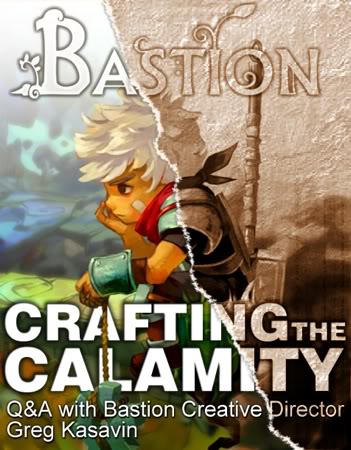 Bastion might depict the apparent end of civilization (known as the Calamity), but the process of making this highly anticipated action-RPG is full of life and love.
Before diving into this gorgeous, surreal adventure (due out this Wednesday, July 20 for Xbox Live Arcade), I wanted to learn a little bit more about the philosophy and design choices behind it. Greg Kasavin, creative director at developer SuperGiant Games, shares with us some of the nuances of orchestrating Bastion's unique narration element, what he brings to game design from his journalism background, and why the main character suffers from premature graying.
Bitmob: What's the story behind the Kid's novelty-sized hands and white hair? Is he that stressed out over the end of civilization?
 Greg Kasavin: It's fair to say that the Kid is probably pretty stressed over the end of civilization. Just look at his face on our box art! His life has never been easy, and now that the whole world has shattered to pieces, it's turned even harder...but a lot more interesting.
One of the key design goals around our protagonist character was to make him empathetic, the sort of character you feel for but not necessarily the sort of character you wish you could be. Many if not most adventure and fantasy games are based on power-fantasy-style characters -- all muscle-bound and smooth-talking and so on. But that wasn't the type of experience we wanted to create with our game.
We wanted you to feel something for this character other than envy, to want to help him to succeed as well as to play out his story. So we came up with this kid who's kind of scrappy and down on his luck but always prepared to pick himself up and keep going. He's lean and lanky, but he's used to getting his hands dirty. And yes, the white hair is another detail meant to support these ideas. It gives the Kid an indeterminate age, to make him look like he's already been through a lot before the events of the game.
Bitmob: Why make Bastion's narration reactive, what challenges did that add, and how did it change the game?
GK: While the idea of making Bastion a fully narrated experience wasn't there from the outset of the project, we did know we wanted to make the sort of game that stood a chance of leaving a lasting impression on players and aimed to use narrative as a means to that end. We wanted the game to be more than just fun to play. At the same time, it was important to us that we never interrupt the gameplay for the sake of the story.
At the outset of the project, these goals seemed to be at odds. But during the course of prototyping, we discovered this reactive narration technique was just the solution we were looking for.
Our narration technique was made possible by our access to outstanding voice talent in Logan Cunningham, who was rooming with Darren Korb, our audio director in New York. They're mutual friends with Amir Rao, our studio cofounder, who was prototyping the design of the game when he asked if Logan could record a few lines.
The effect was dramatic -- it started bringing the world of the game to life even before we had any real visuals. It allowed us to express the emotional range of the story that we wanted. The narrator could be serious, could make you laugh, could make you feel like something important was at stake. Also by having the narrator respond to how the player is performing or what he's doing, we were able to make the events of our story feel personal to the player.
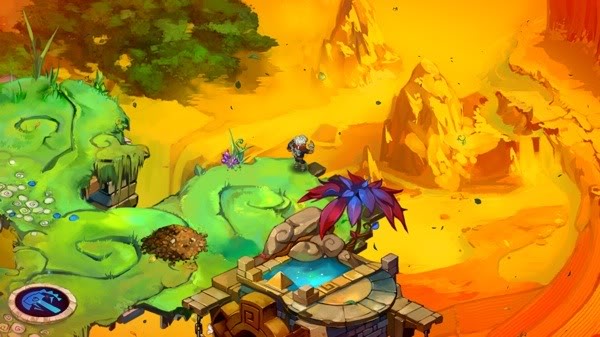
Working on the narration was a very rewarding aspect of the project, in part for all the challenges that came with it. First off, there was just a lot of writing to be done. We had to reconcile the moment-to-moment experience of each of the game levels with the high-level story we wanted to tell.
We also wanted each level to have numerous unique moments for the player to discover yet never to repeat any gags -- or repeat any of the narration, for that matter. We pushed on the writing very hard, iterated as much as possible, re-recorded any of the stuff that didn't sound just right. Darren and Logan recorded dozens and dozens of times during development. We had to make sure the performance was consistent, that the tone was right. It was an intensive and exciting process.
We also had to go in and make sure the timing and flow of everything was pitch-perfect and tuned each line of audio down to fractions of a second to get it to sound natural. This was labor-intensive, and yet the narration added so much dimension to the game that it was always a pleasure to work on.
Bitmob: Was the plan always to have the narrator sound cool and rugged, and did you consider any other voice types?
GK: We knew the kind of tone we wanted for the game even before we had narration in it. Darren was already working on music in that rugged frontier vibe, for example – his name for it was "acoustic frontier trip-hop", as he combines these frontier themes with more exotic and modern rhythms. The narrator's voice in Bastion sounds nothing like Logan's natural speaking voice, though, and the very first iteration of our voiceover sounded a lot different. It was closer to what you'd probably expect from a narrator in a fantasy setting. But from there, in just a matter of days, we quickly found the voice we ended up sticking with.
Early on in the project when we were exploring the tone we wanted, we were talking about this idea of, what if the great American author Cormac McCarthy wrote fantasy video games instead of writing these vivid, hard-edged stories about the American southwest and the evil in the hearts of men and all that? He's written Blood Meridian, No Country for Old Men, The Road, and others. The atmosphere he creates is amazing, as he paints these beautiful and desolate landscapes with these intense characters who don't need to say much to say an awful lot.
So we were interested in that kind of feel for our game, minus the terrible evil and the terrible violence, because video games have enough of that already and we wanted a somewhat more uplifting and optimistic tone. So with all that in mind, Logan delivered the voice we wanted. We made sure to define our narrator not just as a voice but as a fully developed character with his own detailed backstory so that anything he ever said in our game could be rich with subtext and emotion.