

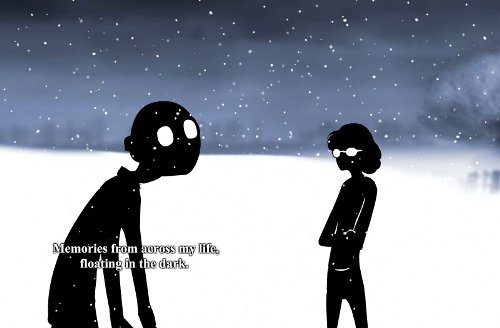
The last installment in our IndieCade finalist interview series features Andy Nealen for Osmos, Andre Clark and Minor Battle, Spectre's Jamie Antonisse (see screenshot above), Modal Kombat by David Hindman, Sowlar, Tyler Glaiel and Closure, and Babsi Lippe and Lev Ledit for Papermint.
[Read IndieCade Interviews Part 1]
[Read IndieCade Interviews Part 2]
[Read IndieCade Interviews Part 3]
[Read IndieCade Interviews Part 4] << You are here.
Osmos - Andy Nealen
What's your game about?
You play as a circular being, called a "mote," in a 2D universe filled with other motes. The goal is to become the biggest or absorb a specific target mote. The only way to grow is by colliding with smaller motes, thereby absorbing them. Collide with a larger mote and you will be absorbed, which leads to "game over."
Our game shares some similarity with other "eat or be eaten" games such as flOw, Orbient, or the cell stage of Spore, but there is a significant difference: To move your mote, you must eject bits of your own matter into any direction, so as to receive an impulse and move in the opposite direction.
This causes the mote to shrink, leading to an interesting trade-off between player size and motion. The player must always try to balance size vs. getting to the next smaller mote to absorb. To this basic gameplay variant we added gravity motes that attract or repel other motes, sentient motes with varying AI characteristics, antimatter motes, and puzzle-like levels. Add to this the ambient soundtrack and dreamlike visuals of the game, and you have our current vision of an "ambient physics game."
Why'd you make it?
This is mostly Eddy's doing (Eddy Boxerman is the director and lead designer of Osmos). He had the early vision and dedication to create Osmos from his basic idea of coupling propulsion to player size in a mostly relaxing game environment. We all share his desire to create games that create a sense of relaxation and serenity, while at the same time providing an interesting challenge to the player.
As it turns out, it's surprisingly hard to make a game "relaxing," while at the same time steering clear of "boring." A lot of work went into tweaking the game, physics, sound/music ,and visuals such that these two seemingly conflicting goals are in balance. This is a challenge we simply couldn't pass by...and we always wanted to make a game!
Other reasons? Well, we love the indie games scene and play a bunch of these games. Osmos is our contribution to the community, and hopefully some of us will be able to make a living from this. We think that we still have a few tricks and ideas up our sleeves :)
How'd you make it?
Eddy, Dave Burke, and I met each other in grad school (University of British Columbia) way back in 2001. We're all avid gamers, and spent many hours playing games and talking about video game design, instead of working on our course projects. I'd say the idea to collaborate on a game was born in those days.
Fast forward to late 2006, when Eddy sent me the first basic prototype of Osmos. It was pretty clear at the time that the propulsion mechanic was something very unique and special. In the summer of 2007, Eddy had added the very first sentient mote. This newly added challenge was so intriguing that, during a visit to Eddy in Montreal, I decided to jump aboard for the 2008 IGF submission deadline, for which Kun (Chang) provided the artwork.
We didn't receive any nominations that year, but some very thoughtful and encouraging jury reviews. Dave joined the team in the spring of 2008 to add to the expertise and seriously polish the game and engine, leading up to the 2009 IGF submission, four nominations, and the D2D vision award, which pretty much brought us to where we are with Osmos today.
Of course, none of this would work without the beautiful soundtrack, for which we were lucky enough to acquire great musicians such as Loscil, Gas/High Skies, Julien Neto, Biosphere, and more. These days, Eddy and Dave work full-time for Hemisphere Games, but this was not the case until recently. In this respect, Osmos is a hobby project of four people that took us approximately three years from the first prototype until release.
What did you learn?
Where to start? Well, first off, making and completing a game, no matter how simple it might seem at first during prototyping, is incredibly hard!
That said, it is very, very rewarding to see a project through to completion. But even as I write the word "completion," it immediately comes to mind that we needed to cut so many great ideas to keep the game focused and "tight." While this might not be news to musicians, filmmakers, etc., we needed to learn this the hard way. I think it was George Lucas who adopted Da Vinci's quote "Art is never finished, only abandoned" to the motion picture industry, and I can wholeheartedly subscribe to this.
Now that we have completed Osmos though, we very much like the "minimalist" appeal that reviewers and players have been pointing out to us. In fact, I'd say we have adopted the idea of "game design minimalism" as one of our core philosophies. In a nutshell, we have learned to leverage the strengths of a small team, and hopefully have created something unique in the process.
What's your pick to win the Jury Award?
Hm. That's a tough one, since there are so many incredible games in that list! That said, I'd have to go with Shadow Physics, due to the very fresh ideas in the current (rather early) version. In the sense of full disclosure, I should add that Scott Anderson is a friend of mine :). Other finalists I have played, thoroughly enjoyed, and can wholeheartedly recommend are Eliss, Zeno Clash, Closure, and The Path.
Minor Battle - Andre Clark
What's your game about?
Minor Battle is a multi-screen game that brings the gameplay out from the digital space of the game screen and into the physical space of the players. It's a game that requires players to physically move around a multi-screen setup in order to play, and it results in a unique experience where people cooperate and compete in both spaces. It's a game that draws in all kinds of players, including those that aren't gamers. Everyone has fun with it, and it's something Peanut Gallery is really proud of.
Why'd you make it?
Peanut Gallery is always looking for ways to challenge the traditional setup of a game. With Minor Battle, the question [was] whether it was possible to make a game where the action in the physical space was just as important as in the digital space.
We made a simple concept screen: an enormous panoramic image that wrapped around a room, and the promise of a game like that was immediately clear. The act of moving around a room while controlling a character was something people were naturally drawn to. As designers, ideas that do that are something you really have to jump on.
How'd you make it?
On the software side, Minor Battle was made with XNA and TorqueX, programmed in C# and using various tools on the art side.
On the hardware side, Minor Battle was made using a PC with two video cards outputting to four different monitors, which are then set facing outwards in a "cube" setup. Players control their avatars using four wireless Xbox 360 controllers.
Minor Battle took about a year to complete from pre-production to its current state, with the team size fluctuating from 20 to four or five people. We've also had some new people come on recently to help polish up the art side of the project.
What did you learn?
Minor Battle has been a really great experience for everyone at Peanut Gallery, and we've learned a lot. The design of Minor Battle tended to revolve around multiplayer mechanics, including co-operative and
competitive types, and we feel that we've made good choices and learned a lot of things that will help us make compelling multiplayer games in the future.
One of the main takeaways for us was that it's impossible to put every idea you have into a game. Considering the technical and logistical challenges of Minor Battle, it was good to make a small, contained experience that we could refine and make sure was a lot of fun for everybody. Of course, that has left us with a lot of ideas that we'd like to explore in future Peanut Gallery games!
What's your pick to win the Jury Award?
There are a lot of great games at Indiecade this year, so it's hard to pick just one. Obviously we're biased towards our own games, and we're really excited to have two Peanut Gallery games represented this year --
Minor Battle and also Spectre, made by the Vaguely Spectacular team and headed up by Peanut Gallery member Jamie Antonisse. We haven't had time to try out all of the other games yet, but we're looking forward to trying them on the IndieCade show floor.
Spectre - Jamie Antonisse
What's your game about?
Spectre is a biographical platformer; the player travels back and forth through the memories of a 73-year-old man, trying to piece together a story. On every playthrough the player can seek out a different path, uncovering tales that range from childhood fears to [a stint at] a doll factory to the character's last true love. Each time you finish a game you're building up a bigger picture, and unraveling a little more of the mystery of Joseph Wheeler.
Why'd you make it?
I'm living in Los Angeles, and I miss the snow. More importantly, though, my grandmother passed away last year after a long battle with dementia. When I thought about all the stories she used to tell, it occurred to me how poor any one summary is at encapsulating a life. Somehow, that little idea turned into this complicated game.
How'd you make it?
With a team of eight talented friends, Flash, XML, and a thesis year at USC. Without the thesis year, I would never have been insane enough to spend so many sleepless nights writing and designing something so completely out of the ordinary. Without Flash and XML, I wouldn't have been able to come up with an idea and see a prototype in action within hours. And without the team contributing art, code, blood, sweat, and weekends, the game would simply not exist. It's theirs as much as it is mine.
What did you learn?
I learned (for the thousandth time) how important it is to surround yourself with smart, creative people; they will help make your good ideas better and help you see your dumb ideas for the dumb ideas they are. I learned that people have a really hard time doing two things at once, specifically reading and playing. And I learned that making a game with fifty endings has a downside: No one sees them all, not even you.
What's your pick to win the Jury Award?
Man, I haven't played all those games yet! That's what IndieCade is for!
Modal Kombat - David Hindman
What's your game about?
Modal Kombat -- real guitars controlling classic console video games.
Why'd you make it?
I've always wanted to play video games with a real guitar.
How'd you make it?
Eight spools of solder, 23 ruined games, five years off my life, and 399,232 (and counting) tears.
What did you learn?
That it actually works.
What's your pick to win the Jury Award?
Jury is still out :)
Sowlar - Kyle Holdwick, Ed Kaminski, Rob Onulak, Dan Rosas
What's your game about?
Sowlar is a game about farming. You play as a farmer on a desolate planet in a dying solar system. Your goal is to use the elements around you to work the land and grow aliens, ultimately repopulating the entire galaxy.
Why'd you make it?
We were assigned to make an ASCII game during our freshman year. Graphical constraints aside, we decided to work on a game that was simple and fun, hoping to appeal to the casual non-gamer audience. Yes, we considered Grandma as our target market.
How'd you make it?
We made Sowlar during the final 15 weeks of our freshman year at DigiPen Institute of Technology. With such a short production period, we worked nearly every available moment on our game. Thanks to our amazing teachers and the help of many upper classmates, we were able to do a tremendous amount of work in a very little amount of time.
What did you learn?
We learned a ton about team dynamics, what it means to work together with people seven days a week, eating, sleeping, doing homework, basically living with each other in our school's labs.
What's your pick to win the Jury Award?
Shadow Physics seems pretty amazing. Puzzle games are always welcome, then add an interesting new physics component to that! I look forward to seeing what interesting puzzles they design utilizing this unique game mechanic.
Closure - Tyler Glaiel
What's your game about?
My game is about darkness, the concept of reality, and challenging the player's natural instincts. Everything in light exists, and everything in darkness is the void. If you can't see it, it doesn't exist.
Why'd you make it?
I made it 'cause I felt like it. I like making games, what more is there to say?
How'd you make it?
I made it in Flash, using new Adobe PixelBender shader technology for the graphics. The new version is being coded from scratch in C++.
What did you learn?
I learned a lot, but most of it was in the form of getting a better understanding of stuff I already knew. [With] the new version, which isn't done yet, I learned: C++, OpenGL, OpenAL, SDL, GLSL, and how to make a game in a language other than Flash.
What's your pick to win the Jury Award?
I don't know what the Jury Award is.
Papermint - Babsi Lippe/Lev Ledit
What's your game about?
Lev: Just imagine a new world: flat, white, tabula rasa. My dream was to create a world where a new society is building a better world, where skin color, heritage, gender, nationalities, or disabilities don't matter. The only thing that matters in Papermint is the way of interacting with each other, playing together.
Personal traits and behaviors shall become visible through the characters in the game. People who want to get to know themselves should play Papermint. People who are interested in other people, different people. People who want to talk in different languages, who are playful and active, and creative especially. People who are happy only when they finally are in their own shoes.
Babsi: Papermint is about people, not objects. It is about love, but not the wedding dress (although they are
beautiful in Papermint ;). It is about aggression, but not the gun. Papermint is a playground and offers a vast range of tools to express oneself and find one's place in a society. So, the fun of Papermint is the people.
As art director I was keen on making nice-looking things for the world of Papermint, but I always understood that it is emotions, relationships, and social dynamics that are the heart of the game. However, I'm glad of course when people like and use all the different styles of dresses, hairstyles, houses, or furniture we provide them to turn into their own and differentiate themselves from others.
Why'd you make it?
Lev: I had to. I was always fascinated by real and virtual societies, how people organize their lives in groups, in political systems. But the social utopias online really topped it all. I was in awe at Ultima
Online when it came out.
I also made quite a lot of movies, one of them was even shown in Austrian cinemas, however I was never that happy with the millions of decisions [required] when making a film. I rather prefer the millions upon millions of decisions that have to be made during the development of a computer game. I am good in navigating through bigger systems -- systems that result in stories, because I am not so good in telling them.
Babsi: I wanted to see my characters filled with life. I'm drawing characters since I can think. But at one point I realised that the creative possibilities in our economy...the ways of earning a living with characters is quite limited. I could imagine developing characters for comic books, animation, toys...and GAMES of course. But all of these industries are not really existing in Austria.
Europe as a cultural conglomerate based on the written word, skeptical towards pictures since many centuries, was not the best place for people like me who have grown up with the visual language of Japanese pop culture.
I was a frantic Zelda maniac, and of course watched all the 70s anime shown on Austrian national TV, as they co-produced many of them with Japanese animation studios. Of course, as a kid, I never reflected upon [the fact] that these things are from a completely different cultural heritage. It was an inverse culture shock for me when I was adult enough to understand that I better become a serious graphic designer doing typography.
So I just moved to Tokyo. I worked at a character design studio and refined my "useless" craft.
When I got the call from Lev, an old old friend, to create the graphics for his new game, I was more then ready to finally put my characters on the stage of a proper game! Papermint enabled me to fill my drawings with life. A rare opportunity.
How'd you make it?
Lev: We started about five years ago with work on Papermint. Every single one of the up to 18(!)-strong team has changed Papermint substantially. Babsi is the one in the team who has stuck with Papermint for the longest time, and has probably transformed the game according to her imaginations the most. Thank God!
The choice and mixture of the circle of people who are allowed to touch Papermint is crucial. And it seems our intuition was right. Luck was on our side as well. We do what we like, with the risk that nobody else is interested in what we do.
But we can make sure that we have fun at least. Every single person in our team should be able to understand what is done and play his or her part completely in his or her specific area. Every day is different in our team: Mondays are for talking to the screen, Fridays rather to the BBQ grill. Tuesday is "naked day," and Thursday's everyone is in London.
Babsi: Blood, sweat, and tears. And wonderful friendships. Passion is the key. Doing what we believe in.
Up and downs to the extremes...no marketing knowledge at all...DIY in all aspects. The making of Papermint resembles a fairytale, or a Hollywood movie with all its dramaturgical archetypes.
What did you learn?
Lev: I am happy to say that actually we did not do any major mistakes. However, we were subject to almost unreal amounts of luck and misfortune. From (almost evil) world domination and 20 employees, back to a one-man-enterprise, in order to launch a charming world domination scenario again ;) -- step by step. This works much better, we are on the way, and four again.
Babsi: Friendship is more important than a project. Even if the project is a wonderful thing like Papermint.
Because of this belief, this project -- Papermint -- is still existing, prospering and growing, although our company almost died. And although the prospect of multimillions of dollars was hanging over us like a
sword of Damocles, our friendship was never in danger.
What's your pick to win the Jury Award?
Lev: Our golden bikinis on stage? ;)
Babsi: I want Lev to finally get public acclaim for his work. And our team, of course. It is hard in games to get personal recognition for being different. That's why I'm so thankful that events like the IndieCade Festival focus on art, creativity, and personalities in games instead of the usual genre categorizations and marketing demographics.
We might have been schmoozed by the bigs of the big in the media and game industry, but in the end, we had to go our long way all alone. Until the last drop. And we will continue like that -- the indie way. Because of this we indie game makers are all rock stars. We all are suffering, fighting, thriving, urging...our passion keeping us alive. The whole world out there should know that we are human beings behind these things called games, wrongly put into the cold, emotion-deprived corner of IT.
Games are more human than many other media -- made by humans for humans to experience human emotions. We are not computers and that's why game makers deserve awards...and all the satisfaction, glory, glamor, celebration and pride connected to it. And bottles of champagne :)


