

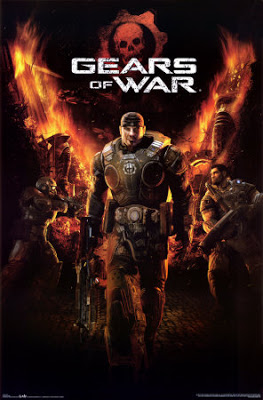
 Editor's note: I think Jon has overblown the influence of Gears of War on gaming. Several of his points were (sometimes admittedly) introduced earlier in other games, like third-person perspectives, cover systems, and chainsaw weapons. I'd also rather stick with a traditional health bar than have my screen obscured and "bloody." What do you think? -Rob
To look back on Gears of War now and wonder what all the fuss was about is easy. The story is fragmented at best, the lead characters have the combined depth of a puddle, and at times the movement was clunky enough to feel almost tank-like.
Back then, though, Gears of War was as close to revolutionary as the industry gets, and without it we'd be playing games very differently today.
For one, we'd still be experiencing most of our shooters in first-person.
Perspective
In the span of a couple of years, most of the biggest games now use an over-the-shoulder camera viewpoint as opposed to the first-person perspective. Of course, I'd be insane to claim that every game has made this leap when that's clearly not the case; on reflection, the biggest first-person shooters released today use that perspective because of those series' long histories with it.
Games like Call of Duty and Killzone focus their gameplay systems around the close viewpoint afforded by first-person so much that to change this for a sequel would make the games completely unrecognizable. Modern Warfare is -- for better or for worse -- always going to be a first-person game, and Gears of War will likewise (in several years time when first-person inevitably comes back into fashion) remain in third-person.
So, why did this shift occur? You could point towards the increased graphical fidelity afforded by this generation of consoles and claim that developers have always wanted to work with an over-the-shoulder camera; therefore, they just couldn't make the perspective look good enough until now. A cynic might argue that this change has only taken place so that marketing executives can cash in on the wave of appreciation for Epic's seminal shooter, and there's probably quite a bit of truth to their claims.
Of course, there's another argument which claims that the only reason you'd go for such a camera angle is to be able to jump on another bandwagon.
Cover systems
Again, I'd be crazy to claim that cover systems hadn't existed before Gears of War. How often did players in Timesplitters crouch behind a waist-high object, only to stand up briefly to unload a couple of shots before crouching once more?
Cover systems have existed for years in the minds and strategies of gamers, but Gears of War finally took what we've always done with complicated strafing and crouching techniques and mapped it to a single button.
Needless to say, Epic's streamlined cover system was genius. Gone were the stalemates that often punctuated mid-level encounters (that, I'm sorry to say, still existed in Resistance 2), as were the insane bouts of circle strafing required against tougher enemies.
The solution was simple, elegant, and -- dare I say it -- cool. Who doesn't love frantically sprinting for cover, only to be ousted by a well placed grenade at the last minute? It's almost ironic that an innovation that revolves around hiding has the effect of making you feel like such a badass.
Subtle guidance
It's a small point. Something that -- to my knowledge -- didn't exist before this game's release, but allowing players to hold a button to point out items of interest is pure genius. Some might argue that having such a button is an admission of failure by the developer -- that a level should be designed in such a way as to direct the player toward things of importance. But not every studio has Valve's ability in this regard.
Even the best games have moments where I don't know where to look, and this problem only increases when large set pieces are displayed outside of cut-scenes. To entirely remove camera control from the player takes a huge amount of confidence. The "hold-a-button" method is a perfect middle solution for such a situation.
The traditional health bar is empty
Like many of the concepts that Gears altered, thinking about the way things used to be often illicit a response akin to "how the hell did we ever get by otherwise?" from me. A health bar to denote the player's life is such an arcane way of doing things that I wonder why games still use the mechanic today, especially now that health-regeneration is almost standard.
I don't think that the screen fading and becoming bloody is any more realistic than a bar consisting of hit points, but when everything's going to pot, enemies are closing in on your position, and you're close to death, don't you want the entire screen screaming at you with this information? Call me overly progressive, but I'm glad health bars have died out.
Now, if we could just simplify ammo counters in a way that doesn't involve displaying ugly numbers on my gun's hilt, I'd be one happy bunny.
Hello, I'm the Unreal Engine -- soon I'll be powering everything
The future always looks far shinier than the present. Although Crysis 2 screenshots give my eyeballs a bubble bath, but I just know that there'll be something even better over the horizon.
Gears of War managed to both show off the best of the present and hint at the great things which were to come over the next few years. Of course, we had no way of knowing that the Unreal 3 Engine would go on to power damn near every other game released this generation.
But when Gears loaded up on our shiny, new HDTVs for the first time, a combined thought reverberated around the world: "Oh," we said to ourselves, "so this is what games look like now."
To list all the games that have taken inspiration from Gears would be impossible, so I won't even bother trying. Suffice it to say that the landscape would be very different today without the game, even if chainsaws on guns didn't quite bring about such a plethora of imitators.
Oh, just so you know, I'm not dead.But you already guessed that, right?