Home
Home

I like Kingdoms of Amalur: Reckoning for what it attempts rather than what it accomplishes.
The Big Huge Games team at 38 Studios clearly wanted to maximize player agency by creating a highly polished hack & slash. Unfortunately, Reckoning’s combat doesn’t quite deliver. That it gets so close makes its flaws all the more glaring. What should heighten immersion diminishes it.
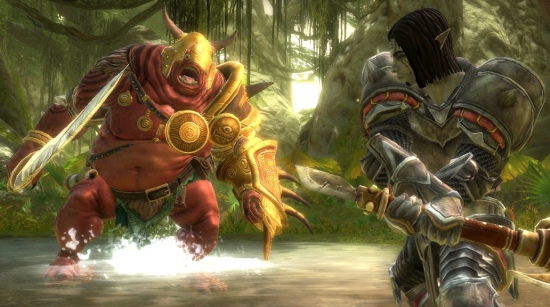
Not nearly as compelling as it looks
When we talk about facilitating immersion, we refer to several elements that encourage engagement: world building, sensory stimulus, and player agency.
RPGs like The Elder Scrolls 5: Skyrim take player agency to one extreme. The level of interactivity far outstrips most games at the cost of polish. Action games take it to the opposite extreme. In God of War, Kratos plods along linear corridors dispatching waves of enemies.
However, this simplistic description sells the genre short. Well executed action titles work by generating an experience called “flow,” a term coined by psychologist Mihaly Csikszentmihalyi. We feel it when our skill just matches the difficulty of the task at hand. Working toward the goal challenges us without frustrating us.
In the throes of flow, we concentrate so intently on a task that we literally can’t focus on anything else. The result: complete absorption. The outside world may as well cease to exist. In games, distraction works just as well as detail to draw players in.
(For a more detailed treatment of the concept, see Bitmob community writer Nathan Jedziniak's Leveling up with "Flow".)
RPGs, for all their world building and interactivity, don’t generally do this. They do distract on a much wider scale: players won’t worry as much about what’s on the other side of the far mountains (nothing but a skybox) if they’re too engrossed in the diversions on the near side. The resources needed just to make such a massive world generally preclude the focused effort required to create a tight combat system. But some developers have tried to bridge that gap.
With Mass Effect 2, Bioware created an intense sense of urgency in combat. The obvious influence of Gears of War works to its advantage. Enemies flank aggressively through environments riddled with side paths and entry points. Vicious and unyielding, they work to overwhelm the player. Flashy effects vie for attention, encouraging a state of mind that filters them out. Upping the difficulty a bit demands complete focus from even a Gears veteran.
Similar scene, more tension
Unfortunately, Reckoning’s combat is both too mechanical and too easy to achieve this. Enemies amble in sparse groups and hang back almost timidly, each waiting for its turn. Bumping the difficulty to maximum buffs enemy health and power slightly but doesn’t force the player to change strategy. Designs and effects lack character and fail to engage. The game falls prey to the oft heard complaint that, “I just pressed attack over and over.” (To be fair, I also dodged some.)