Home
Home

Selling DLC that's already on the disc does get under my skin a bit. Justify the practice however you want, but I'd still feel swindled to a degree. William agrees, and he's provided another nine discomforts with digitally distributed content for you to ponder.
I am Will Harrison, your liaison into the world of what irritates this week as we delve into the top 10 things that I despise or dislike about downloadable content (DLC) and digitally distributed games. I would like to make a note ahead of time that -- much in the style of my literary and comedic hero George Carlin -- I must ask that you not take everything I say here as my full beliefs and the truth. After all, nobody can be this sour as to have something to complain about every week. Truth be told, I am a happy individual with a wonderful life; however, I have no qualms about playing devil’s advocate and pointing out what needs to be said.
10) Nickel-and-diming people? God, no. It’s more like five-and-10-dollaring people. Microtransactions have proven to be a distribution method that the large companies absolutely love: You charge a slightly lower entry-level fee and dole out content piece by piece, which gives consumers a sense that they are saving money. But, seeing as I live in this little thing called “reality,” I am here to tell you that this is simply a grand and glorious illusion created by these companies to make you, the consumer, feel all warm and fuzzy inside.
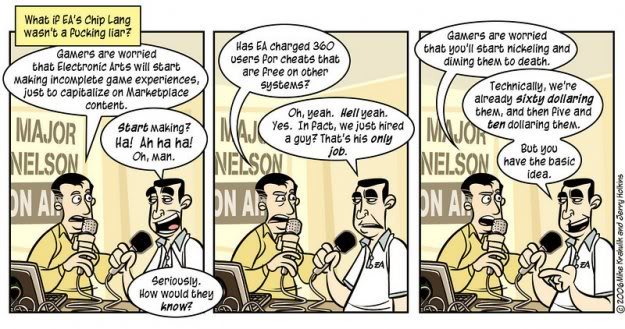
9) But, wait! Buy our “Super Ultimate Game Edition!” So, how do companies avoid the consumer seeing through this microtransation ruse? Simple, really. Months down the road, all of the content that publishers like Electronic Arts and Activision have been pumping out to make their games look more finished will be combined into a "Game of the Year" edition for the price of a full release.
Most view these ultimate editions as a great deal, but truth be told, that “Game of the Year” edition is merely what should have been the finalized product instead of the half-hearted efforts that are initially shoved out.
8) Fan service…of a sort. Sometimes, I think DLC is fitting. After all, who doesn’t want a continuation of their favorite characters and places? It is the whole reason I even bought Final Fantasy 10-2, after all. Although, I feel that sometimes this is nothing more than a hollow effort to keep interest in a title until a “Game of the Year” edition can be thrown together. Most recent examples would be a few of the Fallout 3 DLC offerings, including one that was literally a simulation of a historical event in the game’s canon.
Cool idea? Yes. But it added nothing essential and felt more like Bethesda saying, “we promise better DLC is coming soon, ‘kay?” And it did, in Broken Steel, a DLC chapter that not only added an entirely new end-game storyline but also increased the level cap.
7) Function over flavor. This is a bit of a continuation of point eight, but I feel it needs to be stated separately. Is it too much to ask for DLC to have an overarching function? If I am going to be shelling out eight to 10 dollars on new content, I want more than a fluff storyline and a new weapon or two. As mentioned with Fallout 3, DLC that does something like increasing a level cap or adding new abilities is content that I can get behind as a consumer.
On the flip side, DLC like Bonfire of the Antiquities for Assassin’s Creed 2 brought nothing new to the table and was sold in separate parts. Is this not a bit much for content that was supposed to be on the retail disc? More on this later (see point one).
6) Exclusivity? My ass! Minor gripe here, but I despise it when DLC is console-exclusive or time-sensitive. Don’t get me wrong, this is not me hating on Microsoft solely…I am equally mad when Sony has the exclusivity ball in their court. When Scott Pilgrim: The Game was released for the PlayStation 3 first, I felt bad for my friend, Jeremy, who had to wait for a release that he was more excited about than any disc-based retail title.