Home
Home

Now that you've stopped singing the chorus of the Edwin Starr song of which you only know about ten words, or for the culturally handicapped, "that song from Rush Hour", let's get down to business. Yes, there was probably a better title for this article - but it fits, and that's because nothing you say about war, good or bad, is ever really going to capture even a microcosm of its actual reality. I am not a soldier - the only wars I've fought in have been fictional and laughable at best when compared to the real thing, but I have a feeling that many people who have would agree with me when I say that.
Before you click a link to the next “War Games are Terrible” article, no - this isn't going to be a post about how regenerative health in shooters is unrealistic or how one lone soldier has a snowball's chance in hell of winning a war by himself, though I’ll probably mention those things. This also isn't (really) a post about what shooters can do to make themselves more realistic. In fact, I'm not advocating any change at all - only a little critical thought and historical awareness. You see, this is a post about the impossibility of representing war. Because if we as a community are going to continue ravaging fictional worlds with our warmongering, we had at least better be able to discuss it intelligently.
Whether they were aware of it or not, artists, writers and entertainers of other forms have always been grappling with this issue, either by direct address of the problem or by complete ineptitude at understanding it. And although we all can surely agree that gaming is far along in the process of becoming an artistic medium of its own right, independent of film or literature, it often proves insightful to look for parallels in other mediums. After all, if one studies the history of photography and cinema, it becomes apparent that there seems to be a cycle of sorts for new art forms that involves things such as themes, motifs and even the evolution of critical thought. After all, traditional art critics were trolling photography and cinema long before Roger Ebert hated on gaming.
At any rate, let me define the problem I've been trying to discuss. What can you say about war, good or bad, that conveys what it is faithfully and realistically? War is one of the worst things that can happen on this planet, and we bring it entirely on ourselves. Our history revolves around it; our collective memory cannot escape it. This is never more apparent than in our art and entertainment – the list of paintings, sculptures, novels, films, games, etc. that deal with war, even tangentially, extends into infinity. Discuss or depict a war and you run some risks – glorifying it, offending those who fought it or, sadly, not making an insightful comment one way or the other. Too often we interact with war fiction without really thinking critically about what we’re seeing. That doesn’t have to be the case.

As Chris Cosmo Ross illustrates in his article "Call of Duty: Black Ops' Insane Protagonist: Treyarch's Antiwar Message", novels have dealt with this sort of thing before. Both Vonnegut's Slaughterhouse-Five and Heller's Catch-22 deal with mentally unstable protagonists who became that way as a result of seeing combat action in WW2. As far as films go, that same theme is not untouched. Stanley Kubrick's Full Metal Jacket contains a deluge of such characters ranging from the homicidally suicidal Private Pyle to the disillusioned shell of a man Private Joker. Spielberg's Saving Private Ryan is known for its particularly brutal depiction of soldiers storming the beaches of Normandy, with many critics and veterans alike praising the realism with which the combat was imagined. Yet herein lies the problem - when a novel or film is written about a war, no matter the message, it is still a piece of entertainment. After all, very few people would want to watch uncut documentary footage of wartime combat. Apparently we as a people need that narrative line to walk us through to the message that we all know is coming: war is terrible. Is this necessary? Has anyone found a way around it?
In a way, yes. There are films that deal with this theme that aren't even set during a war. One such work, which served as my main inspiration for writing this article, is Alain Resnais' 1959 film Hiroshimamon amour, one of the founding works of the French New Wave. In Hiroshima, A French woman and a Japanese man have a love affair in the rebuilt titular city, each dealing with their own emotional baggage from the war. The woman tries to understand the Hiroshima tragedy by visiting museums and watching documentaries (the documentary footage of Hiroshima used in this film is all taken from reality), but this proves grossly ineffective. Her own memory and mental stability has been shattered by the trauma she faced after she fell in love with a German soldier who was later killed. The driving message behind the film is that trauma - not just war, but any kind of severe emotional or physical trauma, is impossible to faithfully communicate to another human being. This difficulty is only compounded exponentially for something so widely experienced as war. The film itself is a veritable gold mine of commentary on the effects of war on the human psyche as well as the problems of depicting it.
Don't worry – we’re almost ready to talk about video games. So far, we've defined the issue: fiction often fails at depicting war faithfully, whether they admit it or not - mostly because it's impossible to do so. But for better or worse, human beings are nothing if not stubbornly persistent, and I don't see any end in sight to our endeavors to overcome our faults by working them out in fictional realms - not do I want to see any end to it. I just want to make sure that we understand what we're reading, seeing and playing and that we make some progress, even if it's one small step at a time. It is my belief that gaming is the perfect medium to tackle this issue, probably more so in the future than at the present moment, but it still presents opportunities that other mediums to not - namely: interactivity. But there is still a fine line to walk between artistic achievement and glorified violence. To better understand the possibility that gaming presents, we need to look at how popular games are portraying war. I'm not saying that independent games shouldn't tackle the issue, but rather that popular games reach more people and therefore have a better chance of getting their message out. With that in mind, let’s take a look at how the series portrays war and how successfully it does so.
The first series I want to explore is seemingly one of the only ones brave enough to put the actual word itself in the title: Epic Game’s Gears of War series. A critically acclaimed shooter, Gears offers innovative game play and enough gore to satisfy the most sociopathic among us. In the campaign, human soldiers fight an ongoing war against an underground enemy known as the Locust Horde. Though there is much brotherhood among the soldiers and even some emotional resonance with the search for Dom’s wife, there are almost no signs that the series takes itself seriously in any way. The games almost seem focused simply on giving the player more and more grotesque or terrifyingly huge enemies to fight while placing them in strikingly beautiful yet ruined environments. Moments in the story where the soldiers lament the loss of a brother or a city exist simply to try to convince the player that soldiers that they’re controlling aren’t stone automatons. The subtlety, and I use that word very lightly, ends there. The rest of the game’s universe is full of explosive headshots and chainsaw bayonet duels. The enemies have no personality beyond their snakelike hisses or monstrous growls – there is no sympathy there. Gears never really tries to portray war realistically or impart any message about it other than the fact that it’s tough as hell. Instead, it relies mostly on visceral game play and comic one-liners. I’m going to categories this series as “nothing much to say” – but this isn’t necessarily a negative judgment, as it never really aspires to much in that department.
Let's look at the Halo series. Halo is, for all intents and purposes, the equivalent of a Saturday morning cartoon. A one man super-soldier fights a galaxy-spanning war pretty much by himself. The war is a religious one, but the writer's never deign it necessary to really delve into the spiritual motivations of the Covenant. As enemies, they are ridiculous, running the gambit from the admittedly hilarious grunts to giant reptilians and hulking apes. Though the player is engaged in full-out war, the player is never once hit with the sense that every engagement is even a touch unwinnable - and unless the difficulty setting is turned all the way up, there is rarely a feeling that the player is anything but invincible. The last Halo installment by developer Bungie, Reach, tries to introduce a subtle reversal to the series. Players get some insight into how the general public views the Spartans as well as factional divisions within humanity itself. However, it still suffers from the same problem as the rest of the series: cartoonish enemies. Even the twist that the entire campaign is based around a losing battle is weakened by the fact that you’re still an unstoppable, clichéd silent protagonist.
Now, if all the Halo series wanted to be was a B-movie quality game about blowing away monsters and becoming a god among men, there might not be any reason to take issue with it. No one would dare accuse the series of taking itself too seriously. However, the ad campaign designed to hype the release of the third installment was an entirely different animal. There was an extensive viral video campaign in which the developers made faux-documentaries about the battle that took place on Earth, even going so far as to hire older actors to give the videos an aesthetic akin to the History Channel, with veterans recounting their combat tales.
The Reach campaign turned it up a notch, with in-universe propaganda with slogans like “Remember Reach” and videos that are clear attempts to capture the patriotism of similar works made in the 1940’s. Spoiler alert: apparently people five hundred years in the future dress just like us. There’s mothers going off on business trips while soldiers rush past, a couple planning their future, soldiers worrying about insurrections, and a subtitle that reads “Remember when there was a tomorrow”. Now, it’s true that these videos have nothing to do with the game play itself, but they are focused on the story and are explicitly designed to hype the game and compensate for some things the developers felt was missing from the game itself: namely emotional resonance and the sense that this war is in any way similar to the ones we fight in our reality. This dissonance between the outrageous campaign and the wartime propaganda used to hype it leads me to two possible conclusions about the portrayal of war in the Halo series: it is guilty of either taking itself far too seriously, or has absolutely no idea how to take itself. I’m going to file this under “nothing intelligent to say”.
On a similar galactic scale, there’s Bioware’s Mass Effect series. However, the conflict and the enemies are decidedly less childish. The stakes, rather than the survival of humanity, is the survival of galactic civilization itself. But the conflict and the enemies are not where Mass Effect finds something innovative to say about war. Rather, it’s in your allies and the way you deal with them that Bioware’s series sets itself apart and shows us what games might truly be capable of when dealing with this subject matter. I mean, a Krogan and a Turian setting aside differences is no less startling than when Britain and America allied with Stalin’s Russia to fight the Nazis. Okay, now that’s out of the way – Mass Effect blends game play and narrative choices in a way that mirrors reality. While you never get the sense in the games that you’re fighting a conventional war – after all, you’re not commanding any armies and outside of cut scenes there aren’t any large-scale battles taking place, there are some aspects worth mentioning. Gamers, take notice: in the real world, squads of soldiers don’t all go marching off to battle with rocket launchers and shotguns – they specialize. One soldier might be a sniper, the other might deal with explosives. Mass Effect recognizes this. Fighting some AI? Take your electronics specialist. Taking on some biotic terrorists with the same squad, however, and the outcome might not turn out as well.
This aspect pales in comparison to the more significant decisions that the games force you to make. In war, people die, and it’s not always the fault of the enemy. Commanding officers make tough decisions that sometimes mean that they’re sending soldiers to their death. Mass Effect takes note of this, as well. The first step is differentiating your teammates from the typical expendable soldiers seen in military games. Good writing and voiceover work allow the players to care about the other characters. On one level, it would be bad enough if Wrex or Garrus died randomly in battle. But forcing the player to decide whether to save Ashley or Kaiden makes it an entirely different game. Making sure that you’re sending the right characters to do the right missions in the climax in the second game ensures their deaths or survival. Now while thematically this game isn’t world-shattering, the way the mechanics work with the story lend it a drop of realism in the sci-fi ocean. Other games could take notes. I’m going to file this one, strangely enough, under “slightly in touch with reality”.
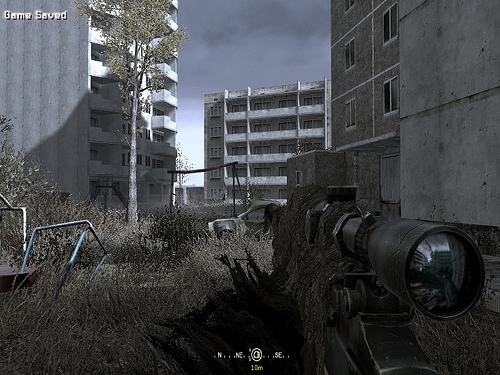
The last series I’m going to take a look at is a no-brainer: Activision’s Call of Duty series. Even from the beginning, this series was on the path to getting it right. Yes, you are a silent protagonist in every game, but this time it’s for a reason. Gone is the notion that one man wins a war. Though they probably could have sold copies just by letting players shoot Nazis – after all, who doesn’t like shooting Nazis, the developers strove for historical accuracy and their own brand of realism. The player takes control of a faceless scrub – one who can’t accomplish his mission without the help of his fellow soldiers. This is something refreshing, but as the years went on the series obviously couldn’t continue to reproduce WW2 with the same mechanics and hope to survive. Thus, the Modern Warfare series. Though there are many outrageous moments such as detonating nukes over Washington D.C. to harness the power of electromagnetic pulses or a river-raft chase that ends in the player yanking a knife out of their chest and winging it into the eye of the traitorous American general, the series as a whole makes leaps and bounds when it comes to the depiction of war.
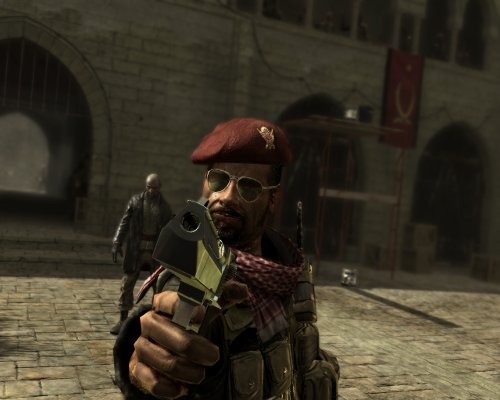
Despite being a wildly, record-breakingly popular mainstream series, Call of Duty loves to mess with the conventions of its genre. Let me ask some questions. In the first Modern Warfare, how long after those thugs shoved you into the back of that car did you realize that the game wasn’t going to miraculously give you a gun to fight your way out of your impending execution? After fighting your way through the city to rescue the crew of that downed chopper, after the nuclear bomb goes off out of nowhere, after you wake up and realize that you’re somehow not dead, did you really think that you were going to make it? Moments like these are great because they try so hard to dispel the notion that just because you’re in control of the character does not by any stretch equate to safety or security.
What strikes me most about the Modern Warfare series are the environments. The campaign of the second game takes you to many locales – ice climbing in Kazakhstan, running through markets and favelas in Brazil – all of them highly detailed and beautiful in their own ways. But let me ask another question: when you were running through that market or the apartments in that favela – did you stop to think about how people actually live there? Not in the game world of course – most of the residents are long gone, but in reality there are places like that. Maybe you didn’t. It’s okay, neither did I. Those English villages with their Nazi-bombed Tudor houses, those favelas with the militants hocking grenades at me through broken windows – those were just more game environments to me, mere maps with beginnings and endings.
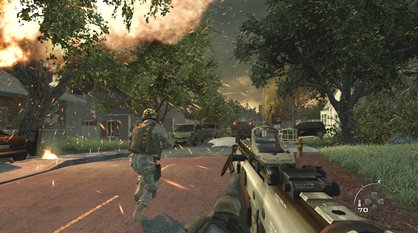
That was, of course, until I fought through that suburb in Virginia. I ran through garages and living rooms fighting off ultranationalist soldiers. I saw remnants of the evening news on a mostly shattered television. I sprinted through people’s backyards and took down an enemy chopper from the confines of a hamburger joint. As I played through this I couldn’t help but think “Wow, this could happen.” Not the whole game of course, but the chance exists that a ground war could take place on our own soil. Surely soldiers have trained for this possibility. Maybe that level was a bit of a leap for you. That’s fine. But what about the Chernobyl mission from the first game? Sure, I’ll admit that there aren’t men crawling around in ghillie suits (as far as I know) but the tragedy that happened there is real nonetheless, and the developers took note of that and tried their best to bring reality into their game. For reasons like this, despite the grandiose plot twists and ass-kicking Captain Price, I’m going to file this series under “on the right track”.
I’ll admit that my list and my conclusions are far from exhaustive or even correct, but I hope that after reading it, hopefully at least one gamer comes away with the notion of how to think critically about Halo 4 or Call of Duty 14. I think that interactivity is the key aspect that sets gaming apart from other mediums, and I strongly believe that this budding medium can help us overcome some of the problems that occur when depicting something as traumatizing and all-encompassing as war.