Separator

What Happened to High-Concept Games?

Pshades-s
Friday, May 28, 2010

Editor's note: Could a return to "high-concept" gaming draw in bigger crowds? I think Daniel is on to something here -- many iconic titles that immediately come to mind when discussing video games fit this description. Perhaps this, and not waggle or 3D, is the answer to reaching and retaining a larger audience. -Rob


I recently had the pleasure of watching Taken, a 2009 film featuring Liam Neeson rampaging his way through Paris to reclaim his kidnapped daughter.

At a lean 93 minutes, the movie surges forward at a great speed. Neeson wastes little time dispatching his on-screen enemies, and the movie doesn't bother with extraneous characters or sub-plots.

Taken is a “high-concept” movie: You can lay out the essential elements in a single sentence -- as I did above. Indeed, the title alone is a succinct take on the entire plot, which makes it high-concept itself (like Snakes on a Plane or RoboCop).

Yet as these types of movies reach millions of people every year, developers burden video games with increasingly convoluted narratives and obtuse titles. We should have more high-concept, accessible games to choose from -- way more.


A look back at early video games reveals an entire industry driven by high-concept fare. Pong, Space Invaders, and Breakout are just three classics that require but a scant few words of explanation to enjoy. In part, this reflects the simplicity of the technology at the time, which limited the scope of early titles.

But technological restrictions weren’t the only reason high-concept games were more common -- fewer titles overall also played a role. You could make a baseball game and call it Baseball. Even when games explored new ideas and got a little weird, the title was often a clear indicator of what to expect. Flying ostriches aside, Joust’s high-concept name is as straightforward as they come.
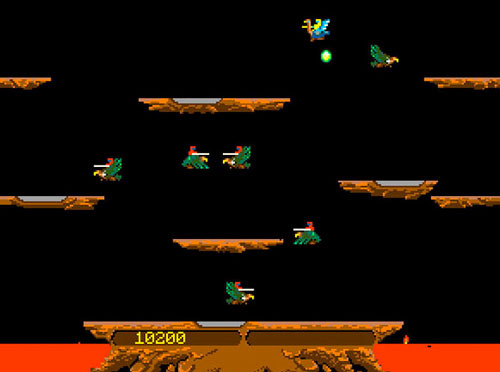
Nevermind the ostriches, it's Joust. They're jousting.

So what went wrong? Years of graphical advancement, an increasingly crowded marketplace, and a bit of hubris have left video games on the edge of mainstream entertainment looking in. Unless a person actively follows industry news or aggressively loiters in retail stores, the average consumer has precious little information to work with when choosing a title.

Brand names aside, what the hell does Halo: ODST mean? Red Dead Redemption? Splinter Cell: Conviction? Even I had to look up the name of that last one, and I inundate myself with gaming news every single day of my life.

A few notable exceptions exist. Portal is a perfect example of a high-concept game with a descriptive title that is approachable and easy to explain. So is Left 4 Dead, actually, which serves as a reminder that Valve is very good at reaching out to customers.

Generic sounding titles Guitar Hero and Rock Band drive music games to million-seller status. The same goes for the Wii: Sure, the name of the console doesn’t make much sense, but Wii Sports, Wii Fit, and third-party titles like Just Dance have proven to be huge hits.

Rest assured, I am not calling for an end of “low-concept” gaming. Bioshock has a perplexing title and can hardly be summarized in a single sentence, but it’s one of the greatest games I’ve ever played. Noby Noby Boy is a delightfully nonsensical title in name (it makes a bit more sense in Japanese) and in operation, but I enjoy its inscrutable nature.

Rather, I would hope that publishers figure out that bigger games with better graphics and more buzzwords (Multiplayer! Leaderboards! Co-op! DLC!) isn’t going to get more people into the pastime. Instead, simple and accessible titles are more likely to draw crowds of new customers -- some of whom will stick around for the next triple-A blockbuster.

Hollywood uses high-concept material to fill theaters while movie critics celebrate more complex films. Complicated video games are all the rage with the Metacritic crowd while high-concept, indie software struggle to reach an audience.

Of course, even a hit video game is nothing compared to a hit movie. Tim Burton’s awful Alice in Wonderland will draw more eyeballs than any game will this year. Tell me that doesn’t drive you crazy.

Lest I sound like Chicken Little, the sky is not falling. Video games are big business these days and have come a long way from sharing shelf space with Barbie dolls at the local Toys "R" Us. But as a gamer, I want to share my favorite hobby with everyone. I want gaming to be something I can enjoy with my entire family instead of something I do while they sleep. To be sure, they’re not put off by the controller or the prices: I’ve got everything they could want ready and waiting. The games themselves are simply too intimidating.


Daniel Feit was born in New York but now lives in Japan, where he teaches English to Japanese children and writes for Wired Game|Life. Follow him on Twitter @feitclub or visit his blog, feitclub.com.

 
Problem? Report this post
BITMOB'S SPONSOR
Adsense-placeholder
Comments (15)
Default_picture
May 27, 2010

Yeah, sometimes I wander through GameStop and I completely ignore games that I haven't heard of. Obtuse titles don't appeal to anyone, even gamers. If I can't tell what it is by looking at it, then I don't stop.

Default_picture
May 27, 2010

I see what you're getting at. Trying to explain Bioshock, even to a Sci Fi afficianado, takes a good twenty minutes. The effect is "preaching to the choir"- gamers know about and anticipate these games while outsiders could give a shit.

That's why The Beatles: Rock Band is featured on The Today Show and Red Dead Redemption is not.

Pshades-s
May 27, 2010

Travis,  what's frustrating is that Red Dead could easily qualify as a high concept game - everyone knows what a Western is - except I've been playing for at least an hour and I have no idea where the story is going. That's not wrong, of course, but it's a shame Rockstar isn't doing more to appeal to non-gamers. Their work is exceptional in the gaming world.

Default_picture
May 27, 2010

@Daniel- Agreed. I think the fundamental weakness of sandbox games is a cohesive storyline. In GTA 4, for example, you're all over the place working for a pretty strange group of people. In the end, the revenge plot suffers from countless silly fetch quests that comprise most of the game.

In that regard, I think the DLC episodes for GTA 4 are stronger stories. Because they're shorter, they focus solely on the main character and their goals.

Pshades-s
May 27, 2010

I think it's unfortunate what happened to GTA. GTA3 was a revelation, Vice City was a refinement. Those two games were wonderful high concept playgrounds open to all. Then San Andreas exploded with far too many ideas and, while very successful, certainly turned away a fair share of people. GTA4 went all "serious" and I never finished more than four missions. I've all but given up on the series now which is a tragedy.

Again, I know the series makes a ton of money and they've got no reason to change their ways. That doesn't mean I can't look back on their earlier, more accessible games with fondness.

37893_1338936035999_1309080061_30825631_6290042_n
May 27, 2010

I liked your article, but I think it's important to stress that having a high-concept name isn't enough. Sure, You could rename Halo "Space Shooter," but that's just a high-concept band-aid on a low-concept game.

Pshades-s
May 27, 2010

You're right Chase, titles aren't the root of the problem, they are merely a symptom. Sequels in particular can be difficult because they are aimed at an audience that already knows the brand. Still, a good name can communicate a lot. Look at Dead Space. Immediately you've got two general impressions of the game: dead (horror) and space (sci-fi).

Default_picture
May 28, 2010

Try Killzone for another example. 

I don't think high concept games are gone by any means, I just think they are not the games we discuss. Peggle, Trash Panic, Flower, Ace Combat (I can go on) are all single idea games. It is true where we find tjhe majority of these games has changed, and there are more diluted game concepts in the wider market, but they are still there. 

Default_picture
May 28, 2010

Another concern might be that if the 'single idea' idea goes overboard,it could make the game short.  At 60 bucks a pop I want to play a while.  That being said, I don't think developers should just tack on more stuff to make the game longer; gotta start with a good idea and make a good game in the first place, ie Dead Space.

Mikeshadesbitmob0611
May 28, 2010

You did an excellent job here of introducing the concept, giving examples, and providing enough rhetorical balance so your audience doesn't think you're calling bullshit on the way games are today. Because that's too common in most op-ed pieces.

Good show.

Alexemmy
May 28, 2010

You sold me with Joust.

I believe the plot of most games -can- be summed up in a high-concept sentence.

eg. Bioshock:

"An extreme Objectivist community, located under the sea, falls apart, and you must deal with the aftermath." Of course, that assumes knowledge of what Objectivism is, but I believe it's a reasonable high-concept take on Bioshock's plot.

The issue with games, of course, is that plot, unlike in film (a more passive form of entertainment), is often secondary to enjoyment of the experience, rather than central to it. Giving you the plot of a game doesn't tell you the mechanics, the game genre, what makes it fun, etc.

So, you try and simplify the mechanics so these more nebulous concepts can be explained in a high-concept. While this leads to some great games like the PopCap games, I think trying to make high-concept games to draw in non-gamers leads mostly to trash like the shovelware that comes out in a steady stream on the Wii. This won't draw in any new gamers for the long-term, when they play the crappy game and realise they wasted their money, and question the value of gaming in general.

Besides, I'm not really interested in making gaming more accessible. I believe you (using the general you) take things on their own terms rather than expecting them to change for you. If I went to the movie theatre, saw a title like, say, 'Eternal Sunshine of the Spotless Mind', and said 'that sounds dumb', choosing to watch something else instead and missing out on a great movie, I believe that's my fault for not doing a little reading first, not the filmmaker's fault.

I don't care how many people enjoy a game I liked, only that I enjoyed it. It doesn't drive me crazy that 'Alice in Wonderland' will have more people see it than play my favourite game, because if they don't play the game, that's their loss, not mine.

Pshades-s
May 30, 2010

I hear what you're saying about game plots, D.E.B. Wilson, but a high concept plot needs to be summarized in a SIMPLE sentence. Your example doesn't cut it. And at the risk of sounding bleak, if gaming doesn't reach out to more players in certain areas, there simply won't be enough money to sustain the industry. You cannot exclusively cater to the audience you've got - no business can. There's a reason Coca Cola, perhaps the most recognizable brand on Earth, keeps spending money on ads and trying new flavors.

To use the movie comparison again - total US video games sales, 2009 (admittedly, including hardware as well as software): $19.66 billion USD (http://www.npd.com/press/releases/press_100114.html)

Total US box office + DVD sales, 2009: $18.6 billion (http://www.reuters.com/article/idUSTRE5BU0HS20100105)

Percentage of children who play video games: 97 per cent (http://www.dailytech.com/Study+Shows+97+Percent+of+Kids+Play+Video+Games/article12985.htm)

Essentially, the video game market is bigger than the movie market by dollars, if not by eyeballs, and growth in the market will come as more and more kids grow old enough to play games. Growth may never come from older people who don't currently play, but it's not really a problem - the kids are digital natives and they grow up with games.

Or, as Douglas Adams would put it: Don't Panic!

Brett_new_profile
June 02, 2010

I wholeheartedly agree, Daniel. Game developers are nearly as bad as aspiring musicians when it comes to picking obscure names. A little mystery is fine -- but let's keep it simple, guys.

You must log in to post a comment. Please register if you do not have an account yet.