Home
Home

Video game movies. Even those very words strike fear into gaming and film fans. So often the two mediums have attempted to combine their efforts and yet time and time again, they end in dismal failure.
There aren't many video game movies worthy of recommendation, unless you're interested in bland, uninteresting spectacles with nothing more than poorly developed eye candy. Perhaps last years Prince of Persia came closest, but even that was met with scorn from critics despite its relative financial success.
What's more, none of these video game movies are ever really that popular. Just look at these charts of some of the most successful video game movies of all time, via IGN:
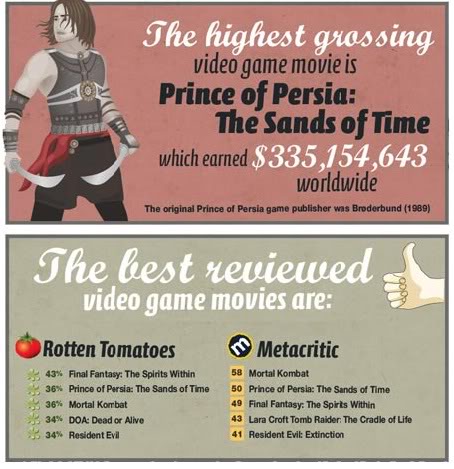
Clearly, none of these movies were very successful at the box office. Nor have they been given positive reviews.
So what's the deal? Why are video game movies so horrible?
To be fair, it's not as if the video game scene is giving screenwriters anything good to work from. The amount of video game stories that could be easily adapted into films easily is razor thin, and those that can be would command budgets worth hundreds of millions of dollars
If you look at most screen adaptations from books or plays, one of the main element already within the texts are well-defined, fully formed relationships between characters. They have hundreds of pages to flesh out a charter, developer their motives, fears, desires, etc, before putting them on the screen. They are complete, with complex relationships and arcs, before any of their faces fill a frame.
How many games could you name off hand that accomplish this? I've written elsewhere about why characterisation in games needs a lot of work. Could you name even four or five games that have their main characters develop through complex arcs? Even one or two?
Certainly, there are a few. Perhaps Ezio in Assassin's Creed, or even Fisher in Splinter Cell. Hopefully Lara Croft in the upcoming Tomb Raider reboot will provide a good story - all of the elements are already there. Despite the actual film franchise sucking big time. Twice.
But most people couldn't name any more than a few. And that's fine, but it really highlights just how poor characterisation is in video games. You may not notice it when distracted by the task at hand, (finishing the game), but when moving the story to another medium only then do you realise how thin it really is.
But when it comes to adaptations, video game developers arent giving their cinematic counterparts much to work with. In lieu of charact development we have high budget spectacles and explosions to hide the fact there isn't much of a plot at all. And why is that? Wouldn't writers be able to come up with a passable narrative for these games?
As the web series Extra Credits has pointed out, most of these plots are based on cut scenes rather than the game as a whole. They ignore the treasure trove of information available in the actual gameplay, and instead focus on the one part that many gamers seem to hate the most. I've lost count of how many people I've met who say they skip the cut scenes just to get to the game play.
The main problem with this is that the cut scene as a format isn't designed to be treated as a narrative arc. In its purest sense the cut scene should develop the characters and set up the information for the next mission. By relying on these cut scenes for character development, video game movies are selling themselves short. They're doing the exact opposite of what gamers do - skip the gameplay for the cutscenes.
As a result of this practice, the lack of character driven video game adaptations really exposes how little attention developers give to personality arcs and story in their games. They put all the character development into cut scenes rather than focusing on the narrative as a whole. Whereas a game like Dead Space uses the in-game action to inform the narrative, others like Mass Effect place such a heavy emphasis on the cut scene that these cinematic form the basis of the entire narrative. Again, this might be passable for a game, but when turning this into a movie the writer will focus only on those and ignore the narrative that's gone into the rest of the game.
The conclusion here is simple. More developers need to spread narrative direction and exposition throughout the entire game, and not just the gameplay, if a proper story is to be constructed.
But perhaps this isn't the game industry's fault. After all, they're not the ones making the movies, right? It's up to the director, production team and actors to make sure they are making the best movie possible.
However, so far they don't appear to be doing a great job. Even the best reviewed video game movies have some pretty terrible actors, and the one film that finally gets a decent budget and cast, (Prince of Persia), has a horribly convoluted plot and atrocious dialogue. Max Payne wasn't much better.
They don't have the best writers either. Prince of Persia was written by Boaz Yakin, known for Remember the Titans, Doug Miro, who didn't work on much at all before that, and three other credited writers. It's common for blockbusters to be shipped around from writer to writer, but when you're already working with thin material it's hard to get a good story going.
These games have a fairly limited audience too. Sure, a hardcore gamer may go and see Max Payne to see if it's good or not, but it's unlikely a random stranger will go if they have nothing better to do. To be fair, the industry has improved on this with a massive marketing campaign for Prince of Persia. It seems like a solid, big-budget action adventure in the trailers. But with such well-known brand names like Mortal Kombat branching into movies, people already turned off by the games won't check out the movies at any cost.
Can you blame them? The video game movies brought out during the 1980s and 90s were terrible. Absolutely terrible. Those in the 200s have been worse, with Doom the shining beacon of low quality filmmaking. You can't blame major studios for not wanting to bank on these types of films, and you certainly can't blame A-list actors and crew for not wanting to be involved in them.
Here's why video game movies are mostly terrible: because the video games they are adapting give filmmakers nothing to work with, there is no incentive to produce a film that is worthy of the source material.
However, there are signs this is beginning to change.
As previously pointed out, Prince of Persia was given a good run. With a tight-enough budget and marketing campaign that brought in millions of customers, the elements were there. The only big problem was the script, which could have been tightened up. The actors would have benefited from better material, giving them something to work with as well.
There is also hope that actors are beginning to see video games as a viable medium in which to work. As reported in VG247, studios are now approaching video game developers to do voice-over work with the industry now being seen as legitimate. According to Bethesda's Todd Howard:
With a lot of these actors, there is a cool factor now to doing a video game. It’s not about the money. It’s about, ‘It’s really cool and my agent tells me it’s going to be good for me now instead of bad for me'.
With such a change of heart, it's not hard to see actors associating that with video game movies as well. With the right crew, and a solid script, there may one day soon be a video game movie that serves as an example for the rest of the industry. It happened with comic books - until the early 2000s comic book movies were terrible as well. But with serious approaches such as X-Men and Spiderman, they became the "next big thing".
Of course, comics have a much bigger repertoire to work with. But video games are starting to find their way. After all, there are plenty of games and characters that could serve as the basis for a fleshed-out narrative - Isaac in Dead Space, Ezio in Assassin's Creed, Fisher in Splinter Cell and even series like Portal could produce interesting films.
The industry is beginning to have faith in itself as well. Recently, Ubisoft set up a film production division and started working with production companies on producing scripts and hopefully getting some deals done. With franchises like Splinter Cell and Assassin's Creed, it's hopeful that we'll see a well-produced and backed video game movie within the next few years.
The industry isn't there yet. And the filmmakers aren't going to get there on their own. Developers need to show them that they can make rewarding games dripping with narrative and character - only then will movie makers be interested.