Separator

Why Final Fantasy 13 was a success (part 3): Expanding the overworld

Pict0079-web
Tuesday, April 26, 2011
EDITOR'S NOTEfrom James DeRosa

In the first two parts of his Final Fantasy 13 retrospective, Jonathan discussed the battle system and the story. In part three, he defends what is probably the most derided aspect of the game: its supposedly excessive linearity.
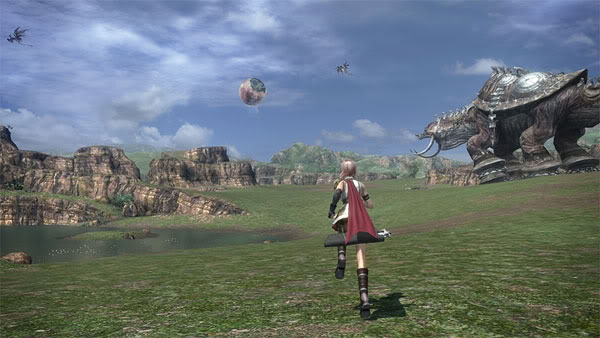
The Archylte Steppe in Final Fantasy 13

I hate when people argue that Final Fantasy 13 is too linear. Although they're halfway right, it makes it clear that they barely bothered to scratch the surface of the title's expansive wilderness.

People often throw a fit about how the game initially restrains the player, forcing him or her to trek through narrowly defined environments. Even though it looks like the journey is heading toward a single destination, the humongous settings take on a life of their own throughout the experience.

Take chapter three of the game as an example: The trip across Lake Bresha begins as a long jog across stretches of intricately rendered icescapes. However, after a few minutes, players will notice that the lake is frozen for miles and miles. Even the tossing and turning waves seem stuck in time, forming icy mountains. A supernatural force like no other is clearly at work here.


One of the main characters, Snow, soon encounters the possible cause of the phenomenon. In his final stand against an army of soldiers, two magical figures come to his aid from out of nowhere. They are special summon spirits known as the Shiva twins. After a heated battle, Snow learns to transform the spirits into a crazy ice motorcycle.

As the game progresses, players encounter even more sublime transformations of natural environments. And when they finally reach the untamed wildernesses of Gran Pulse, they discover a wide expanse of open pastures that they can freely roam.

The free-exploration section is a shocker when you consider that the game keeps players restrained on a single path for more than 15 hours. The world of Final Fantasy 13 suddenly looks much more real, mysterious, and powerful than ever before. Players can actually run alongside the dinosaur-sized fauna of Gran Pulse.


The environment houses a variety of surprises. For instance, the characters can explore extensive canyon systems and find an abandoned city.

The entire area is filled only with Cie'th, fallen warriors who have turned into mindless zombies. Whenever a person is branded with the mark of a l'Cie, they must complete a Focus. It's more or less a "mission" ordained by a godlike spirit known as a fal'Cie. If they fail to complete their objective, they turn into a zombie known as a Cie'th.

The entire vignette is a strange, surreal trip through a series of mines and ancient ruins. When the adventurers reach the home of Vanille and Fang, two of the game's main characters, they find only a deserted coastal town full of white dust and Cie'th monsters.

It only takes a few minutes of exploration before the player pieces together what happened to all of Vanille and Fang's friends in the village. Oddly enough, the entire party is sporting l'Cie brands of their own and may soon suffer the same fate. One can only imagine what would happen if the entire world were cursed with the fate of a l'Cie.

This entire second half is one of the most remarkable sections I've ever experienced in a Final Fantasy title. Final Fantasy 10 was the first entry to include attractive and detailed polygonal characters; Final Fantasy 13 achieves the same feat with regard to the environments. The game truly immerses players in a haunting and palpable world of awe and wonder.

It's not just a world of linear exploration. It's a 3D environment that takes on a life of its own, playing a unique part in the story of the game. Only the protagonists can determine whether or not anyone will live through the chaos that comprises the very end.

Do you agree that Final Fantasy 13 is a wider experience than the linear maps at the beginning would suggest? Or do you think the developers failed to exploit the full potential of the Final Fantasy 13 game engine? Feel free to write about it in the comments below.

Next time, in the final part of my Final Fantasy postmortem, I'm concluding with a discussion of the game's immense orchestral soundtrack. Make sure to check it out!

 
Problem? Report this post
BITMOB'S SPONSOR
Adsense-placeholder
Comments (13)
Default_picture
April 26, 2011

I totally agree with you, its almost like the people that are complaining about the game arn't appreciating the true beauty of the game itself and only comparing it to previous titles. I can understand the total effor that was gone into creating the high-detailed characters and environments.

Ragnaavatar2
April 26, 2011

Having just passed the Gran Pulse section, I STRONGLY disagree with you. Upon first arriving at Gran Pulse and seeing how the map opens vastly across the landscape, you might be struck in awe about how different it feels against all the linear paths you've been traversing up to that point.

But when trying to advance the story a little, I soon realized that, besides that area, more linear paths await as soon as you change areas or arrive at the specific destination point that's marked on the map. The very city you mention? It's just a couple of houses around a specific path you have to traverse to get to the other side of Oerba village.

Sure, FF XIII has some of the most amazing and beautiful vistas I've seen in a game. But that just only adds to the problem when you try to get closer to something and realize it's off limits because it's not where you're supposed to go.

Lolface
April 26, 2011

The scenery might be pretty, but it doesn't change the fact that you literally, kind of just run in a straight line for the first 20 or so hours of the game.

Gran Pulse is a different story, and by that, I actually mean story. Here's the thing, when I got to Gran Pulse, one of the first things I did was, I looked up. What I saw was a planet (Cocoon) that was so large in the sky (larger than the moon is to Earth), that I have to believe that either Cocoon is just that damn big, or Cocoon is actually floating within Gran Pulse's atmosphere, with no ecological effect. Being somewhat of a sci-fi buff, I could let that go. It should have been explained (and if it was, I completely missed it), but the proximity isn't that big of a deal to me. Not as much as the giant hole in Cocoon.

The problem with the giant hole in the planet is that, if there is a hole so big I can see the light of the core on another planet, then the surface of that planet cannot be any kind of habitable (at least not without some sort of sci-fi info dump of an explanation, which I have yet to find). This would mean that the inhabitants of Cocoon live inside of the planet. Given the artificial nature of Cocoon (and my previous experience with UC Gundam), I can accept that the people can live inside of an artificial planet, but only to a point. How are there beaches? How is there a sky? With stars? What in the sweet blue crap happened to a planet full of people on Gran Pulse?

You can correct me if I'm wrong, but there are no answers to any of those questions. Not within the narrative of the game. To me, that is a world building failure.

As for the running around and non-linearity of Gran Pulse, it's nice and pretty, but ultimately fells a bit pointless. You're just exploring a dead world. Sure, there are dinosaurs and other animals (all of which want to kill you), but there really isn't anything there. Not to mention, the free roaming areas are limited, in both number and scope.

In the end, the linearity of the earlier parts of the game didn't bother me too much, because FFXIII still has a turn-based, menu driven combat system, and constrained environments don't impede upon this aspect. However, the first 15-20 hours moved at a fairly brisk pace, and when you get to Gran Pulse, you are suddenly dumped in an open environment and given free reign to do whatever you want, though the plot remains linear. This effectively kills the pacing of the game. To me, it feels as though Gran Pulse was just a way for Square-Enix to stretch out the gameplay to a degree that fans have come to expect, even though the plot they crafted didn't allow for it.

Pict0079-web
April 26, 2011

@Lloyd: Yeah, I definitely agree. It's a real shame that people aren't considering how much time and effort went into making the Final Fantasy world more real than ever before.

@Carlos: Well, some of the ways in which Square blocked off the paths were pretty silly. For instance, in the beginning of the Gran Pulse area, they had to find a way to limit the party's movement so that they can reach the cutscene with Hope. So they ended up blocking the other pathway with boxes.

There's also another silly section where they block off the path to the chocobos with a forcefield. The only way to get there is by finishing some of the side quests on Gran Pulse. It's a little sloppy, but I still appreciate the wide variety of monster-hunting quests.

I also like the subtle way in which the town was integrated into the gameplay. It's pretty easy to assume that it's just a bunch of buildings that you encounter on the way to the other side. However, that hardly explains the freeway at the end of the area.

It clearly used to be a technologically-advanced town. Something happened though. Something that turn the port into a deserted town with zombies. I thought that was a clever way to tie the empty buildings into the storyline.

@Matthew: You bring up a really interesting point about the hole in Cocoon. Players don't actually examine the inside geography of Cocoon until the very end of the game, when they enter Orphan's cradle. That section really didn't make very much sense. It seemed to resemble the final areas of Kingdom Hearts and it really seemed more like a low-rate science fiction world when compared to everything else.

As for Gran Pulse, there's actually a little more to the story than you're implying. In the narrative, Vanille and Fang clearly remember that they used to live with many friends on their planet.

I'm trying not to spoil anything. Much of the story took place in the past, when Vanille and Fang were forced to make a decision to save their home planet from destruction. Supposedly, they saved it. However, they may not have been able to stop all of their other friends from turning into Cie'th.

What's interesting is that Vanille and Fang don't remember very much of what happened on Gran Pulse. They don't remember what happened to all of their friends who didn't complete their focus. I presume that Square-Enix is going to try to tie up the storyline in 13-2.

You're right though. Gran Pulse was a big section that seemed like a tiresome way to stretch everything out. However, I think the visuals and the massive environments made up for the lapse in the storyline. I tend to think of it more as a Diablo-style quest section, in which I earn rewards for fulfilling the side quests. It also helped me level up my characters for the brutal sections at the end of the game.

Christian_profile_pic
April 26, 2011

God, Gran Pulse is where I burned out on FF13. After the initial 15-or-so hours, I got used to the linearity. I honestly didn't mind it at all. But when I was thrust onto Gran Pulse, it felt like my parents had pushed me out the door at 14 and told me to "figure it out." Without the handholding, I felt lost.

That said, I do really want to go back to it. I'm not adverse to large, open environments -- in fact, they're my favorite -- but the contrast between Cocoon and Pulse within FF13 itself was so jarring that I felt a tad overwhelmed.

I also think that was what they were going for, though. Gran Pulse is alive with gargantuan beasts, vast plains, towering cliffs -- it's supposed to be overwhelming, compared to Cocoon. I liked that the game built an expectation, flipped that expectation completely on its head, and fueled a certain level of anxiety. But considering my real-life anxiety issues, it was a tad too much for me, and I just got burned out,

A year later, maybe it's time to go back and finally explore Gran Pulse with a brave face. FF13 is at the top of my "games I never finished" pile of shame (along with Persona 3). Just gotta re-learn that combat system....

Pict0079-web
April 26, 2011

@Christian: The first few moments of Gran Pulse are really overwhelming. Fortunately, the developers have their limits to the kind of environment they designed. Once you figure out where everything is, it literally becomes a matter of navigating with the world map.

It also includes a unique variety of side quests to progress everything. The most interesting section takes place at Taejin's Tower, a massive structure that looks somewhat like the Leaning Tower of Pisa. Once inside, you get to fulfill tasks assigned to you by the big statues. It felt like a cool version of Tomb Raider, except that the statues were actually helping the characters.

I honestly have more problems with finishing the PS1 Final Fantasy games. I guess I'm still not used to devoting 80+ hours to finish the game. I was able to finish FF6 though, so maybe someday I'll finish FF8...

Default_picture
April 26, 2011

I don't really think I 'overlooked' Gran Pulse. When I got there I was ecstatic that suddenly the game had turned into FF12.

Then after a few more hours I realized that the linear part had gone on so long that I was already burned out on the game. Which is a shame, but though in the past I might have tried to power on anyhow, I'm old enough now to realize there's no point in playing a game I no longer want to play, even if I would have loved to be playing this game 15 hours ago.

Dscn0568_-_copy
April 26, 2011

Though it doesn't excuse the game's linierity, there is a storytelling/meta explanation for Final Fantasy 13's level layout. Spoilers ahead:

Pretty much the entire game except for Gran Pulse is the heroes doing exactly what the Cocoon fal'ce want you to do. The villains want you to get stronger, so of course they put you on a straight path with gradually stronger opponents to level up on. After the airship battle, the party is then sent to the Fifth Ark, a literal training course.

By that time, everyone is tired of being jerked around and decide to go to Pulse and look for Fang and Vanille's village. This is the first time they decide to do something for themselves and the first time they're away from the highly regulated life of Cocoon, so Gran Pulse is intentionally much more open and free. Eventually the fal'ce force the party to return to Cocoon and follow their linear confusing plan to its conclusion.

Of course, this explanation could just be complete hot air. I also know it doesn't fully explain the Sazh/Vanille sections since they were just trying to not get captured, though the theme park is slightly more open than previous areas.

Pict0079-web
April 26, 2011

@Ron: That's too bad. I know that the first section is pretty limited, but I was pretty pumped up from destroying a giant helicopter in one of the previous chapters. I was actually hoping to blow up more helicopters in the chapters after that one, but I think I was pretty happy with killing humongous dinosaurs instead.

@Chris: Well, Gran Pulse was also a mysterious section that also went along with the Cocoon Fal'cies' plan. More spoilers ahead:

If you recall from the end of chapter 11, Barthandalus set a whole slew of crazy plans in motion when the party left for Cocoon. Even though the entire coup d'etat only led to more nonsensical chaos, it was enough to provoke the party to return to the regulated world of Cocoon for a final showdown. And of course, this eventually led to a meeting with Orphan at the very end.

And yeah, it doesn't really explain everything that happened with Sazh and Vanille, as well as a whole bunch of other things that happened. I think the return trip to Gran Pulse really stirred up Fang though. We don't really see Fang's distraught emotions until the end of the game, when she almost makes a dreaded transformation to cause massive destruction for the sake of her friend.

I wonder if Vanille and Fang will reappear for the sequel. After all, they're still stuck in that odd place where we didn't expect them to end up.

Default_picture
April 27, 2011

I find this article very informative about the content of the game, but I find no evidence to prove the point that heads your article.  You see success is a achievement of original intent and thus I do not feel this game succeded at all.  I felt the story was well recieved, I also feel like it was moving in the right direction, but I do NOT think this game is worthy of being called a fantasy game.   Which as defined by its own title I do not believe it succedes.  This is supposed to be the fantasy game to end all fantasy games, and I think that if you name a game as such, it should have something to do with the game. 

Pict0079-web
April 27, 2011

@Kurtis: Um, have you ever played any of the Final Fantasy games? There's been more than 13 Final Fantasy games. I wasn't saying that this was the fantasy game to end all fantasy games. I was just saying that it was a step forward for the video game series.

And why wouldn't it be called a fantasy game? It has the standard fantasy weapons, monsters and the type of story. Maybe you're just not used to Japanese RPGs. The Japanese concepts are slightly different from their western counterparts.

Default_picture
April 28, 2011

Actually, at this point I should boot the game up once more. Still have the save so maybe it'd be fresh again. Darn you.

Christian_profile_pic
April 27, 2011

@Kurtis: when you say "fantasy game to end all fantasy games" are you referring to the title, 'Final Fantasy'? If so, that's not what it means; the series is called Final Fantasy because, at the time of the first one, it was Square's last shot at a hit game. Even still, I fail to see how the series, 13 included, isn't "fantasy."

You must log in to post a comment. Please register if you do not have an account yet.