Home
Home

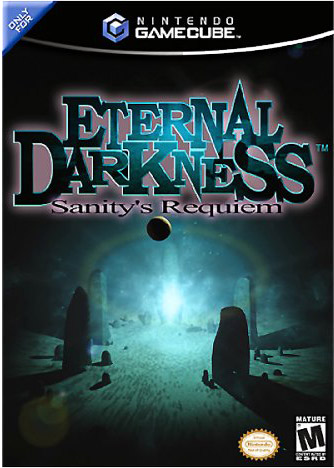
Editor's note: Alex and Matt Giguere use the first edition of the community-created series Backlog Brigade to discuss the GameCube classic Eternal Darkness. Along the way, they try to figure out what exactly makes a classic game classic.
If you're interested in participating in future Backlog Brigades, check out the notes at the bottom of the article. -Brett
 Working your way through your massive pile of shame can be a daunting task. But I've thought up an ingenious plan to get me through the slog: recruit fellow Bitmobbers to play along with me. They'll encourage and motivate me -- and best of all, we can talk about the games together after we play them.
Matt Giguere stepped up to the plate to take on the first game on my list with me: Eternal Darkness. Our resulting conversation turned into what I think is a worthwhile discussion about the challenges of designing a "timeless" game.
Alex: I'm not entirely sure how this conversation should go. Any ideas on what we could talk about related to Eternal Darkness? I was thinking about how it's definitely a product of its time and could be slightly impenetrable to new players.
Matt: When you say impenetrable, do you mean how time has treated Eternal Darkness compared to current games in the survival horror genre?
Alex: I mean that I felt like developer Silicon Knights barely explained the magic system at all. Perhaps they assumed people knew about the circle of power aspect because of marketing for the game, or because gamers would be able to talk it over with their friends.
Matt: Haha, I get what you're saying. I agree -- the magic system was fully explained to me. The first time I played it, casting magic mostly required trial and error, but it wasn't impossible.
Alex: Yeah, looking back now, the magic system seems obvious, but it was extremely obtuse and poorly explained when I played. I didn't even fully understand that I had to go to the menu and put the runes together to make the spells, or that I could make stronger spells with the 5-point circle of power. Daniel Feit had to explain that last point to me on Twitter. I feel like if I had been playing the game right after its 2002 launch, reading the previews and reviews, talking about it with friends, I would have figured out everything much more easily.
Matt: Indeed. The same thing goes for the combat. They never explain that you can dismember enemies until the end of the first level. Maybe Silicon Knights wanted players to take their time, but that seems a rather sloppy way of doing things. Then again, I think we're nitpicking what is overall a very good game.
Alex: If Chris Davidson were here, he would probably pipe in that he didn't know you could run until the last chapter.
That wasn't a problem for me because I don't own a PS3 or a 360, so a large amount of my gaming is done on the PS2. Holding down a shoulder button to run is still instinctive for me, and I can hardly fault Eternal Darkness for not having properly explained that. But the magic system and the melee combat represent a huge portion of the game. The problems with those are game breakers.
When I got to the Amazon girl, I died a ridiculous number of times because I was stuck with the blowgun. The game did explain the targeting system, but it didn't do much good. I feel like a simple system where you held a button to target, pushed up to target the head, left for the arm, etc., would have gone miles in helping me out there.
Matt: I do remember that the very first scene in the game puts you in a room with the simple zombies and only a shotgun as a weapon, but in the context of the scene being a nightmare, I think it's supposed to be confusing. In fact, the entire game is meant to be played at a slow pace, and I can see why Silicon Knights chose to construct the combat that way.
In any case, it wasn't too hard for me to pick up since I have experience with the early Resident Evil games.
Alex: Yeah, I haven't played many survival horror games besides Resident Evil 4. If I had, maybe I would've have been so frustrated. But really, I rolled with the punches until about Chapter 9. At that point, I just wanted the damn game to be over already. That drawn-out length seems like another way that game is trapped in the past. Nowadays people are happy with a 6 or 7 hour game.
The real question is: Are these things examples of poor game design, or are they just a reflection of the game's age?