


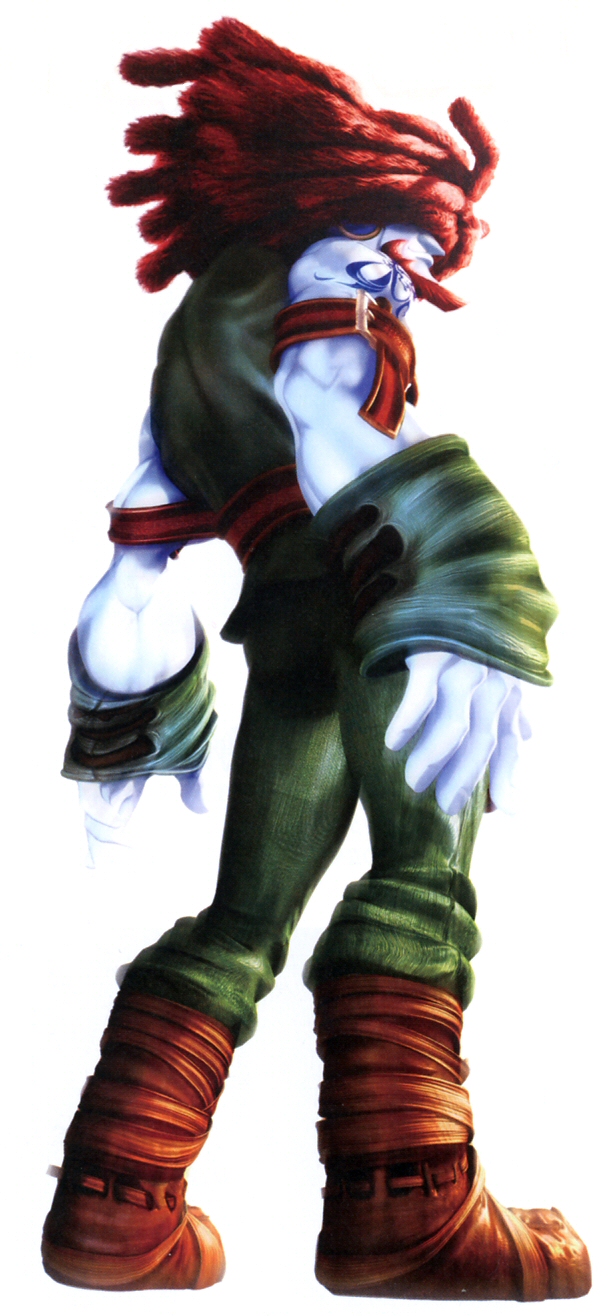
This topic started with an examination of Final Fantasy VII's Cait Sith, and since some friends and I have been replaying Final Fantasy IX I thought I'd follow up with a another character from that series. Amarant sticks out like a sore thumb among the cast of Final Fantasy IX. He's brutish, imposing, devoid of a sense of humor and mostly inconsequential to the game's main storyline. So, why does this lunk deserve main character billing?
Amarant's purpose in the game always struck me as fulfilling more a game mechanic role than a narrative one. Final Fantasy IX was designed to be a tribute to earlier games in the series, including characters modeled after the classic Final Fantasy "jobs." With other characters representing the series' Thief, Mage and Warrior jobs, Amarant is the game's Monk. He possesses all the characteristics of this Final Fantasy class, such as light armor, brutal melee attacks and a versatile ability set that combines support skills, healing and raw damage.
Throw in the ability to...throw (a weapon chucking ability often associated with Final Fantasy's Ninja job) and Amarant is a force to be reckoned with on the battlefield. In a lot of ways he's the most interesting character to use in a fight because he has some of the most combat options. A lot of characters in Final Fantasy IX have abilities that become obsolete partway through the game. For instance, once Vivi has "Flare," the only reason you'll cast "Fira" would be to conserve MP. In contrast, though Amarant has a limited set of powers almost all of them remain useful throughout the game and allow him to assume several different roles. Since Final Fantasy IX is a game that likes to constantly change what party members are available to you, Amarant's versatility comes in quite handy. This is especially true in disc 3 when White Magic isn't a reliable healing option and the player has to depend on abilities such as Amarant's Chakra to restore hit points.
Usefulness in combat aside, it's hard to feel like Amarant isn't just "the eighth character." The player's party is comprised of four characters, another throwback to earlier games, which gave the game's scenario writers a nice, round number to work with on the numerous occasions when the player's party gets separated, such as the attack on city of Alexandria and the quest to the ruins of Oeilvert. If it weren't for these events, I couldn't blame someone for forgetting that Amarant is even in the game. And yet there he is on the game's cover, while arguably more important characters like Eiko are absent.
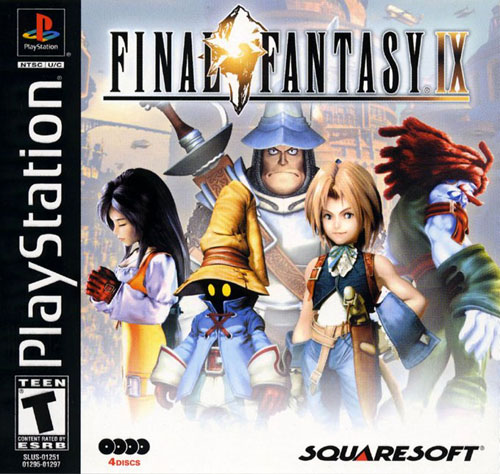
Which brings up the fact that Amarant looks damn intimidating. Standing next to the effeminate Zidane and oafish Steiner, Amarant is a muscular brute with flame-red hair and pale, sickly skin. Though he is often depicted as standing upright in promotional art, Amarant's in-game model more closely resembles a gorilla. His huge arms practically drag along the ground as he walks while his long hair obscures most of his facial features. This makes him look like a cross between a biker, the Hulk and Cousin It.
He's a stark visual contrast, and maybe that's the point. This game released when I was in eighth grades and I knew a few classmates, fans of FF VII and VIII, who were outright offended by Final Fantasy IX's art style. Amarant's presence gave the seemingly kiddy game an identifiable "badass" that Square probably felt was necessary for American audiences.
His main role in the story seems to be to serve as the foil to happy-go-lucky main character Zidane, but his character is never really developed aside from a tepid rescue mission followed by a late game epiphany about the powers of friendship. If you really want to read into it, the fact that the brooding loner is proven wrong by the upbeat, cheerful protagonist could be a commentary on the main characters from Final Fantasy VII and VIII, but I think it's just a trope of JRPG storytelling. Suns rise, seasons change, evil empires scour the world for Magic-Life-Bio-Summon-Gem Crystals, and the power of adolescent friendship can overcome the millennial-old machinations of primeval demon-gods.
And, when it comes down to it, Final Fantasy IX is a celebration of these tropes. It's about paying tribute to the franchise, not making a lot of sense. Why is there an old man in a spaceship blasting quaint medieval villages? So he could be Garland. Why are this world's weapons of mass destruction a bunch of guys in goofy hats? So there could be Black Mages. And why is there a surly loner with ridiculous hair and huge hands? Because the game needed a Monk.
It's a kind of logic that's charming in its own way. Just don't say that to Amarant.