Games need to stop telling us where to go

Default_picture
Sunday, September 23, 2012
EDITOR'S NOTEfrom Eduardo Moutinho

I appreciate a solid map or convenient GPS mechanic in many of the games I play. But I'll agree with Brandon on one of his main points. Developers should allow those features to be turned off.
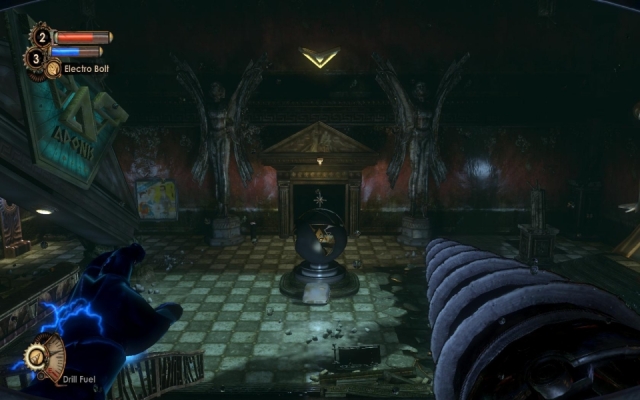
Bioshock 2

If you’re playing Resident Evil 6, BioShock, or any Modern Warfare title, stop and pause the game for a second.

Do you feel someone holding your hand? Does it seem like that person is pushing you toward your goal?

Hit start and return to the game. Take a look around as you battle your way to your objective.

You see it? That big arrow? That target?

Yeah, it’s that reoccurring and seemingly in-demand destination pointer.

I’ve seen them in in the Call of Duty franchise. And that was OK. I didn’t mind being told where the goal was. The games presented straightforward campaigns.

BioShock featured something similar. The arrow, working like a compass, helped me figure out where to go next, but at the same time, it didn’t help me get past the threats that plagued me along the way.

Recently, I took a stab at the Resident Evil 6 public demo. And once again, this GPS thingy was lurking around in Capcom’s latest survival-horror adventure.

Why is it needed?


Resident Evil is all about making it on your own. You have to figure out its puzzles and endure its hellish counterpoints. You find hints along the way, but without an arrow swinging around your radar, the experience feels more realistic. You don't have a big, bright icon indicating where to escape from an army of zombies. You have to find out yourself.

A majority of current-generation games are more forgiving. They hold your hand no matter the consequences. The game’s difficulty doesn’t count. You see, when I grew up, video games kicked our asses. The only alternative (or nice pedestrian who helped us cross the road) was the third-party Game Genie add-on. And that was more than a pointer. It was what I like to call “El Cheapo.” Think of it as the equivalent of hacking at its finest.

Titles were less complex and more straightforward back then, but you didn’t see this absurdly big arrow in role-playing games or platformers. It was more like, “Have fun and good luck. Call Nintendo Power’s Counselors’ Corner if you need help."

I also believe that modern-day navigation takes away fun, and it slaps our general logic in the face.

If you’re going to point where to go, you might as well point to the secrets and off-trail scenery I’ll probably miss out on. Why? Because you’re telling me where to go, stripping me away from what I should be doing: questing off as the hero I’m supposed to be.

Games are meant for enjoyment, and a large portion of that fun (for certain genres) is exploring. We are diving into another dimension. We want to put ourselves into the shoes of the hero or heroine while navigating into the vibrant world so many digital offerings provide.

Marines sure as hell don’t have a target icon to follow during a real-life war, so maybe if developers want to be accurate, they should make experiences more lonesome and not remind me that I’m playing a game.

In-game navigation seems to be mandatory now. Sure, technology has changed tremendously. We all have trackers on our iPhones and carry our GPS devices while traveling. But I still cringe at the idea of current adventures providing these helping hands.

I mean, why make your game so complex if it’s not worth the time to scour all of its pixelated environment?

The Elder Scrolls V: Skyrim is great, and it is how long-enduring RPGs should be. But please, give us the opportunity to delve into its complexity without any help.
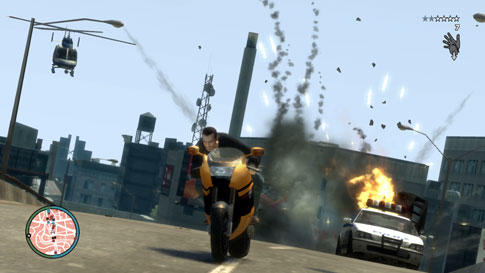
Grand Theft Auto IV

I can understand Grand Theft Auto IV. It’s vast. It’s beautiful. Finding the next objective on your own could result in countless hours (or even days) of running around. But I didn’t want to miss out on every nook and cranny. Finding secret packages while scouring the city with my own knowledge made the game more rewarding.

Did MacGyver have help building a simple stick into a bazooka or traveling in the wilderness? No, he didn’t. He sucked it up. He grew balls. He did it all with his own skill.

Aren't we supposed to be the knight in shining armor that singlehandedly saves the world, rescues the hot chick, or escapes the undead?

If you want a fairy to tell us what to do, at least give us the option to turn it off. Some of us still enjoy taking the road home by ourselves, just like a lone wolf.

It's not a voyage without discovery.

 
Problem? Report this post
BITMOB'S SPONSOR
Adsense-placeholder
Comments (14)
Default_picture
September 23, 2012

Generally speaking, I'm a big fan of Zelda-like maps. You know where you are, what various rooms look like (once you explore them), and where pertinent objectives are.

If you have to stick an objective compass up to get me to my next goal, you've designed your levels wrong.

Default_picture
September 26, 2012

Oh, I don’t have a problem with Zelda. It works great.

One of the coolest features from the original was the overworld map included in the instruction booklet. What a huge adventure.

Good point.

Snapshot_20100211_14
September 23, 2012
Couldn't actually disagree any more than I do. Do you know how boring games would be? The difference between the past and now is map size. It was far easier to remember games before. Please go play Borderlands without any idea on where to go. Or Bioshock. Or really any of these shooters that come out. They wouldn't be playable. They do it because human beings should value their time. If you want to spend your 200 hours wandering around doing nothing, by all means... But this argument is very very poor.
Default_picture
September 24, 2012

So you consider it fun to walk in a straight line the entire game?  Bioshock is not a good example - even without the GPS, the game is essentially a linear experience.  And of course Borderlands needs the GPS since all the environments look the same.  To Sam's point, maps should be designed so the player can make their own observations on where they are and what to do next.  GPS's are just lazy design - a way of getting the player around generic looking maps.

Default_picture
September 24, 2012

I did mention games that offer a vast adventure should still have it. And you’re not doing anything; you’re discovering the world the game offers. A big part of secrets or discovery new areas (like Skyrim) is the simple factor of finding them. It’s exploration.

Resident Evil (since its face-lift from RE4) is straight-forward. I just don’t see the point of having a navigation pointer in such a general action/survival-horror genre. Again, the older Resident Evil titles were about exploring and figuring out what to do or where to go.

Call of Duty…well, it’s the way it has been for a while now and I don’t have a problem with it. For many, it’s: “Hurry, finish the campaign, and jump on the multiplayer.” Not for me.

At least give us a [on] or [off] switch.

I don’t like to rush through games where I would put down $60 of my hard-earned money and be done with it. If you’re following that arrow constantly (without stepping aside to look around off-trail), you obviously have the desire to complete the game without checking out some (or none) of its side quests. Not all are pointed out to you (Fall Out: New Vegas).

I never thought venturing across a huge vibrant world with so many secrets among the way to be boring. That’s what makes it an adventure.

Everyone has different tastes. And yes, I did play Borderlands.

Default_picture
September 25, 2012

Brandon,

I pretty much need to rush through games, I have a pile of more than 150 games that I haven't finished yet, and that pile tends to keep growing more than it shrinks... Of course, part of that is that I tend to play 40-70 hour games. Anything that will make them shorter is a plus for me.

Default_picture
September 26, 2012

You could always ship me a portion of your collection. ; )

Default_picture
September 26, 2012

I give them away or trade them in when I finish them. Other than that, I keep em until they're done or I get disgusted with them.

Default_picture
September 23, 2012

Completely removing these sorts of features would cause a return to the bad-old-days of massive amounts of padding of you having to search around and talk to all the NPCs to find the one NPC that will progress the storyline. While it's a worthwhile idea to make the guidance option a little more optional, I would hate to see it removed altogether. Telltale games have a hint system that could provide a template for that sort of thing. If you wander around for a certain amount of time, it gives you a small hint. a bit longer and it'll give you a larger hint... You could have the compass arrow appear once you've searched a certain amount on your own.

Default_picture
September 24, 2012

I like that idea :)

Default_picture
September 23, 2012

I don't mind a navigation system, but I do mind if its obnoxious and insulting. Really, it depends on the size and scope of the game. Also, sometimes developers design worlds like labyrinths and they to implement more profound navigation systems. Games like Oblivion that have multi-tiered dungeons and 2D map layouts... eww.

The author's argument isn't really poor, I think he has some excellent points. He needed to reinforce the fact that certain games have to ditch them. In reality they do, putting a navigation system into a linear game is insulting. It's the same wuth hints and highlighting objects in the environment. I played Duke Nukem Forever and turned all that crap off because I know I'm smart enough to do it on my own, plus its more rewading that way. Yet there are other games where it would be nearly impossible to get through without it.

So in the end, it's all variable. Each team needs to look at their game and equip it with whatever form of navigation they think works best. Personally, I'm a huge fan of subtle context clues...

Default_picture
September 26, 2012

I don’t mind text-based hints. Even more, I think it’s a neat way to give a hint with bold text. Hints are fun; I appreciate them.

I just (personally) don’t enjoy when the answer is given to you.

Default_picture
September 24, 2012

I feel like the design choices made by Bethesda between Morrowind and Skyrim (and to a lesser extenet, Oblivion) are a perfect example of this.  In Morrowind, players were not given any form of waypointing.  Instead, they had a journal that gave some details on how to accomplish the goal.  Sometimes it was explicit.  Sometimes it was vague as hell.

Compare this to Skyrim.  There is an option to turn off the waypoints for quests but most of them would be next to impossible to do without it.  The journal from Morrowind doesn't exist anymore.  NPC's don't describe how to get somewhere, because the game knows you have a waypoint to follow.

I don't really think this is a bad thing.  There is still plenty off the beaten path to explore in Skyrim.  It just shows how games have changed in the last ten years.

Default_picture
September 26, 2012

Well said, Justin. 

I like going off-trail and just seeing what I would witness on my own.

Of course, I’m going to get stuck in a game like Skyrim. It’s huge.

I never played Morrowind, but you had excellent points – and I think the journal is a nifty (and hellish) idea. Perhaps players could have the option to have the waypoint or the journal clues.

Whatever suits the player; you’re given the option.

You must log in to post a comment. Please register if you do not have an account yet.