


Editor's Note: If Brett Bates isn't a pack rat, we'd be awfully shocked. He is very passionate about the subject of archiving games, having written about it a few times here on Bitmob. But here's an interesting new story about the dark underworld or archiving that very few of us knew about. -Shoe
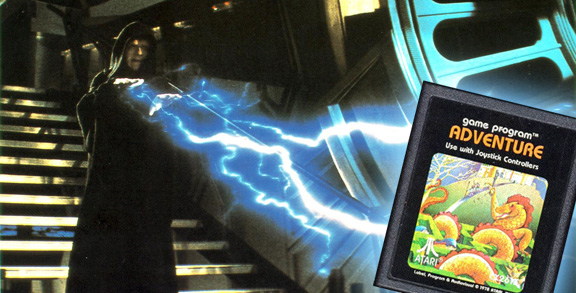
A dark archivist preserves the Atari 2600 game Adventure.
Lately I've been thinking a lot about the dark arts. Not the kind of dark arts your level 70 blood elf shoots from his fingertips in World of WarCraft: These dark arts are artistic works like videogames that enter archives across the country, but due to legal problems typically involving copyright, are never seen or heard from again.
They won't appear on any list of archival collections. If asked about their existence, staff librarians will shake their head and profess ignorance. But in dimly lit, temperature-controlled back rooms, archivists are hard at work preserving these materials. It's just that Joe Q. Public isn't allowed to see them now, if ever. So why do it then?
The existence of dark archives was revealed to me during a panel on machinima preservation issues at the Play-Machinima-Law conference held last May at Stanford University. As an example of legal action taken against machinima work, one of the panelists discussed the controversy surrounding a video created by the artist Dave Beck.
Beck's piece, called "The Highest Score," comprised a five-second video loop from the PS2 game The Warriors showing a male character repeatedly stomping on an unconscious woman. In the upper right corner of the screen, Beck placed a counter that increased every time someone watched the video. His intention was to explore America's obsession with violence, but instead he drew the attention of the game's publisher, Take-Two. Within days, Take-Two's lawyers sent a cease-and-desist letter claiming copyright violation, and Beck's work disappeared forever from the Internets.
Enter the dark archive. By keeping the work inaccessible to the public -- "in the dark," so to speak -- archivists can skirt the question of copyright and focus on preserving things like "The Highest Score" in the hope that someday lawyers can sort out the tangled legal issues.
Sadly, this is the only way that much of videogame history can be preserved right now. The Digital Millennium Copyright Act that governs videogame copyright is a mess, and obtaining permission to preserve a modern game involves more hoop-jumping than the Westminster Dog Show. And game companies aren't any help, either: They don't appear interested in preserving games unless it means they can resell them as a "classic collection" to aging gamers with a bad case of nostalgia.
But the media of games -- floppy disks, cartridges, CD-ROMs -- have a limited shelf-life, and if steps aren't taken to preserve them now, the data will become permanently corrupted. Which means that in order to ensure that future generations can learn about and play the games we care so passionately for, we have to be left in the dark.
Read more about "The Highest Score" here. For other Bitmob posts on videogame preservation, click here.