Home
Home

The video-game industry wants to know more about you, but how much is too much? That's what Ben wants to know, and he's not just concerned by recent hacking scandals. And with so many publishers now requiring separate registration accounts that ask for personal information, losing track of where your information resides becomes increasingly difficult.
I am one of those folks who never entered my credit-card information into my PlayStation 3. Like some sort of paranoid caveman, I donned my tinfoil hat and actually drove to my local retailer to purchase PlayStation Network points on a piece of paper. So let me tell you, did I ever feel vindicated when there was zero chance that my card info was taken by nefarious cyber bandits.
Then the realization struck me that they still took my name, address, email, and any other information I happened to deliver to Sony. So at this point, you’re saying, “Whatever, you probably use Facebook, Twitter...maybe do some online banking. Your info is already in a thousand places!” Very true astute reader, but that isn’t what bothers me. What bothers me is the principle of the thing.
To quote a famous song: “The times, they are a changin." With recent console announcements, a “more personal experience” has become the cornerstone that the big three are building upon. While social media and new technology are opening up brand new ways for us to play games and interact with our friends, the nagging question for me remains “how much personal information am I willing to give these guys?”
In my youth, I logged countless hours on my Nintendo and Genesis consoles, and not once did either of those systems asked me for my credit-card number. As I got older and ventured into online gaming on my PC, I still rarely gave much personal information out.
So maybe Blizzard had a fake name on my Battle.net account. Did Quake 3: Arena ever ask you for your zip code before you joined a match? Me either.
Then, as years went by, a peculiar thing started to happen. I started to have to divulge more about myself just to be able to play games with my friends. When I signed up for Xbox Live to play Halo 2, I never imagined how much of my personal data Master Chief would end up wanting.
Even though Sony is at the forefront of the security debate with their recent debacle, there have been plenty of other security breaches in the recent past. Xbox Live has been hacked, people receive countless spam mails attempting to steal their World of Warcraft accounts, and now the group Lulzsec has been launching attacks against EVE servers and delivering threatening ultimatums to Bethesda concerning the Brink userbase.
I think the PSN hack just happened to serve as a strong wake up call to the gaming community that we’re really handing over quite a bit of ourselves with complete trust to our favorite companies. Still, I have to wonder why they want this information, and has it really helped make gaming better?
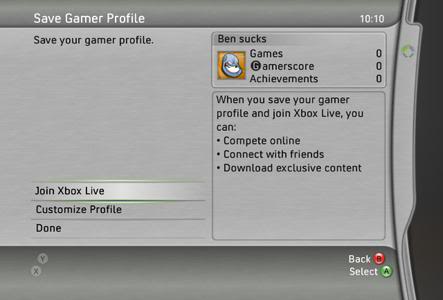
Take, for instance, signing into a game with Electronic Arts' Online Pass. Just to be able to play, I’ve had to give my personal information to both Microsoft and EA. I have no doubt that they are taking the best measures they can to keep it safe, but why do they need it?
Will they use it for some sort of private statistical analysis? Possibly. Is knowing where I live going to help them better improve my multiplayer matches in Crysis 2? I doubt it. I am willing to hand over certain personal information to utilize a social network, a location sensitive app, or pay bills online because they utilize it as a core function of their service to me. Games are by their very nature supposed to be trivial things -- and an escape from irritating responsibilities like paying bills online -- so I question the necessity of granting them all these details.
Before this begins sounding like the ranting of a bitter, old curmudgeon, I love the convenience of this new frontier. The ability to download old and new games at the drop of a hat on Xbox Live or Steam is something I could have never dreamed of as a kid.
But as much as I love convenience, I also enjoy having options, like still being able to use a time card for an massively multiplayer online game or a points card to refill an account. I weigh the inconvenience of having to go purchase these against the importance of my privacy. What I worry about in this brave new world is that my options may slowly be taken away.
The announcements of both Wii U and PS Vita -- along with the meteoric rise of smart phones as gaming platforms -- continue to blur the lines of video games and social media. My greatest fear is that soon I will no longer have the option to play games with my friends and colleagues without divulging a massive amount of private details as the price of entry. I think at some point in the not-too-distant future, we’ll all have to make a choice whether we’re comfortable entrusting our privacy to console makers in exchange for the ability to enjoy new titles to their fullest extent.
Hopefully, we’ll still be afforded the options we have now.