


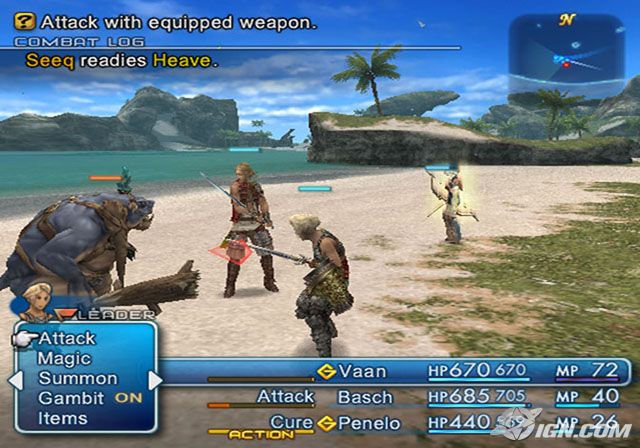
 For the average video games news site, a drought in releases means focusing on the news, doing features, or coming together with whatever it can to keep the clicks coming. For the savvy consumer, the one who simply must keep up on the latest games, it means a reprieve from spending large amounts of money, mostly on games that will no doubt be put off. It could also mean going even further back than what could be deemed as "current releases", back into games we altogether missed because of either lack of interest or money. For me, it means playing Final Fantasy XII.
The RPG usual clichés aside, I was enjoying it. The MMO-style battle system is just enough of a change from the average RPG to make me throw aside the problems I was having with the game (generic characters, played out storyline, way-too-familiar setting), as well as push back the nagging feeling that I should be doing something other than undertake such a long game in such a short and unstable repose.
The feeling of elation at the unique distortion in the common RPG language was short-lived, however. The novelty of how I was playing this new game simply did not withstand an assault by the almighty grind. In a dungeon that had all of one save point, overwhelming groups of enemies (though this turned out later to be untrue, the outcome of our fight being that they were whelmed), I was defeated by a boss in such a way that echoed that, in no uncertain terms, I needed to be stronger.
This compounded frustration caused me to rage quit the game. Becoming stronger meant going in and out of rooms that I had been through previously for the purpose of killing every monster there in large amounts of repetition. This was not my idea of fun. I had other things to do, other games to play. To spend time with a game and have the general sign of progression be that numbers incrementally increase was, to me, not time well spent.
 But why was I mad at having to have my numbers be higher so that I could defeat another set of numbers? I wasn't in love with the story the game was communicating to me, and the reality of the battle system was still determined by sets of numbers anyway. They just weren't in my favor. Not only that, but I had been fine doing that up until this defeat. I had been defeated in this same way before, not too long ago. So why was this moment so crucial?
Was I quitting the game because I lacked the necessary diligence to see something through to completion, or was it because I was mad at what I thought to be a poorly-designed game? Was it the game's fault, or mine? I thought long and hard (while playing another game, of course) of the folly committed and who was at fault. I've had an increasingly frequent habit of quitting games, so perhaps it was that I was more at ease with the thought of abandoning games than I used to be, because there was now always something else to do.
On the flip-side was the argument that this design philosophy of requiring a sufficiently high set of numbers, acquired by monotonous grinding, to advance was a way to lengthen games and archaic. The thought that my defeat was perhaps not caused by inability, but by lack of commitment, something that lead me to believe that I was no longer looking for a game resembling this aged structure.
Eventually, the forces in my head came to a consensus: return to this game, if only as a device into which time falls into, never to be retrieved, with the thought that while this monotony was preventing the completion of more fulfilling tasks, it was a great venue to amalgamate the various thoughts that produce blog posts.
This post was originally posted on My Generation is For Sale. on April 21st, 2009