


This article was originally written for my blog.
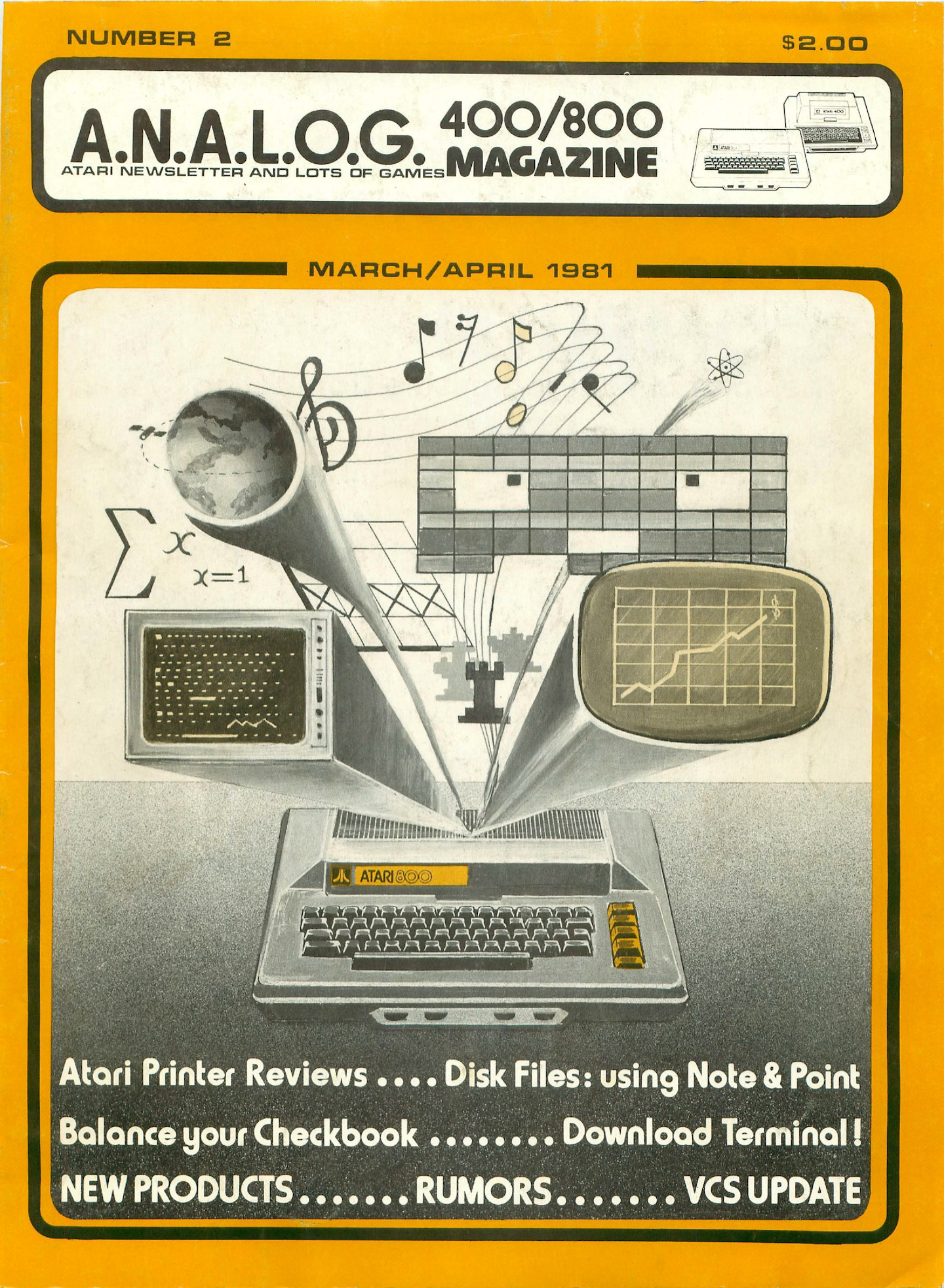 We move on with the issues of Analog Computing with its sophomore issue, for March and April of 1981. As you can see from the cover, we’ve got coverage of some printers for the Atari 8-bit systems.
Editorial
Last issue’s Editorial column was a statement of principles, while this issue’s column is a request for feedback from readers asking what they’d like the magazine to become. They also stated that at the behest of Atari dealers they’ve decided to stop running ads for their own Atari software. That’s kind of disappointing. Yeah, it could be construed as being biased in that you’re not reviewing your own apps, but on the other hand, that they’re publishing their own software provides a bit more clout to their reviews – they’ve developed for the system, so they know what software development for it entails.
They’ve also announced that they’re not going to run ads for mail-order houses or specific retailers. I can kind of get why they’re doing that, but it still feels like a boneheaded move to me. Part of having editorial integrity is, in my opinion, you run ads for the people you want to run ads for, in accordance with your ad policy – and once you’ve set your ad policy, you don’t change it because retailers who carry your magazine get pissy because you’re running ads for competing firms. Considering that last issue they strongly came out in favor of Atari fanboyism, their yielding compromise here feels a little depressing.
Additionally, they’re accepting program submissions, for review, and possibly for listing. They’re also announcing that since they stopped running ads for their own products, they’re depending more on advertisers for revenue instead of subscriptions. Since they’ve also cut mail-order firms and other retailers from their list of approved types of advertisers (which is something that EGM didn’t even do), then this could be a little tricky.
Letters
That was fast. Usually it takes an issue or two to get letters, at least that show up in time for deadline. I guess that being bi-monthly makes that less of a problem.
Our first letter has a possible solution for the program lock-up problem from last issue. Apparently the “BYE” command can clear up lockups like this. I can’t find the details, but presumably BYE is the kill process command. The letter also had a little news tip of interest. Apparently Ham Radio operators who are also Atari enthusiasts were trying to start some sort of Atari Ham Radio program on Monday nights at 8 PM eastern, at 14.329 Mhz. It’s kind of interesting, the ways computer enthusiasts found to exchange information, before Usenet started finding its way outside of academia.
Letter number two starts off with asking about what readers have permission to copy. Remember when you had to have written permission to photocopy stuff? I’m glad those days are over. The writer also runs down a few computer issues that the customer doesn’t have to be in warranty to have Atari fix, even if the computer is out of warranty. Most of these problems involve adding or removing capacitors from the motherboard. Also, apparently crossing your power cable with your printer cable could cause RF interference. God, the loads of cables coming out of the back of my tower would have tremendous problems with RF interference back in the day. We also have an alternate method for making hyperspace jumps in Star Raiders.
There’s a bit more stuff related to contacts on Atari computers, and that Atari might want to switch from their current contact design to gold-plated ones for improved conductivity. There’s also a letter from the head of marketing at Axlon Inc, hyping their new memory module for the Atari 800, that can expand the system’s memory up to a stunning 256KB of RAM. No one could possibly need more than that!
Another writer brings up the TRS-80 and the Apple, and how Atari is the last hope for the industry since those systems are crap and won’t be anywhere in the future. Well, he’s half-right. Finally, we get a very impressive letter from an 8th grader with what is basically an article submission, explaining what the PEEK and POKE commands do. It’s not perfect, but this probably the first time this kid has done technical writing, so I’ll cut him some slack. Wonder what he’s doing now.
Atari News
Atari is working on an accounting suite for businesses. It has an Accounts Receivable system capable of handling up to 300 customers at a time, with a max of 1200 monthly customers. The General Accounting application can handle 2700 transactions a month for up to 750 accounts and finally, Inventory control will handle covering stocks of up to 1000 different items. All in all, this sounds like a decent application for a small business.
Atari’s also working on a word processing application, which I’ve used and I’d say it was okay when I was in grade school, but now I prefer WYSIWYG applications like OpenOffice or even premier.
New Products
First up is a brand spanking new modem for the Atari from from the Micro-peripheral corporation. The modem includes a printer interface, so it can print off everything you see on your screen for later reference, as well as a tape recorder so you can record the information you viewed for playback later. Or, to put it another way, the tape recorder lets you save files. Frankly, that’s kind of awesome. It’s horrifically dated now, and even if I had one of these, I wouldn’t be able to use it as the BBS services would no longer be up and running. Still, were this the 80s and were I a hacker or just a general geek who hung out on BBS services, I’d want this so freaking bad. That said, this would cost $249 in 1981 dollars (approximately $546 now).
Activision has home ports of Kaboom and Freeway for the 2600, both of which have been released for Game Room, and have been covered on GiantBomb.com’s Game Room features. Meanwhile, Automated Simulations has a few games for the Atari 8-bit systems under their Epyx brand. They have The Datestones of Ryn, Invasion: Orion, and Rescue at Rygel. None of these I’d heard of before. Manhatten Software (that’s not a typo – at least not my typo) has a casino blackjack game designed to teach you how to get thrown out of casinos by counting cards. For the record, fuck casinos who treat card counting like cheating.
Disk Files – Note and Paint
We have our first program listing of the issue, with a 100-item inventory management app. While the application isn’t very useful in modern systems, the listing might offer a little useful information on the theory of designing database systems.
You’re Wasting Arrays
A column from Charles Bachand about being a better programmer – particularly with regards to using system resources more wisely. Bachand boasts that the programming techniques he recommends will cut down on memory space used by 80%. First, they recommend using single byte numbers (255 or less) through a chunk of memory (about 256 bytes large) starting at the memory location 1536, or $600 if you’re using machine language. These sections would have to be accessed with PEEK and POKE.
Next, you can hack basic to handle the limitations for array storage. Basically, (no pun intended), in ATARI BASIC, Arrays – places you store variables are designed to only be able to be two-dimensional, and there are some limits to their size in two-dimensions. Thus, if you’re making a lot of variables, you might end up needing multiple arrays. Well, not anymore, as Charles has a hack for you that lets you create 3-dimensional arrays instead. Finally, if you need arrays that are bigger than the 256 byte space at 1536, they recommend using DIM to define the arrays… as strings.
Now, all this programming advice is very useful if you’re doing, say, Atari 8-bit home-brew programming. However, if you’re using anything else then this advice won’t nearly be as useful, as modern versions of C, for example, handle memory usage differently then ATARI basic would.
Rumors
This is sort of like the Quartermann column, but not presented in anything near as interesting a style. Of note in the rumors are:
- a multi-player Star Raiders (fat chance)
- a new OS (maybe)
- a screen dump cartridge (maybe, though I don’t know how useful that would be)
- a voice synthesizer and voice recognition system (I can see the first but not the second)
- an EPROM burner (which sounds fun, lets you author your own cartridges – which could be useful for the modern home-brew community, as well as independent software publishers from the time who want to publish for something other than floppy or cassette – as both of those need external devices.)
- a home port of Galaxian which would in theory step upon the ground covered by the home port of Space Invaders.
- a dummy terminal version of the Atari 400.
- the Atari Program Exchange – a service that will help 3rd party developers get their software published through Atari.
We get an ad for Letter Perfect from LJK Enterprises, a word processing program that boasts the ability to adjust your header and footer, and even delete whole lines of text, all for the low, low price of $149.95.