


I hardly ever play sports games, but I enjoyed this tale about how NBA 2K11 transcended the typical sports-game experience. Even if you're not a fan of sports games either, you should read what Devon has to say. It may change your opinion about this title.
Professional sports simulations are, by their nature, almost unable to move in the same direction as gaming as a whole. While Mass Effect, Uncharted, and Enslaved are free to push narrative forward, the nature of sports games forces them into a position of making their simulations incrementally more accurate year after year. By following along with the dramatic career of the most famous athlete ever to play the sport, 2K has managed to add a pinch of story into their main course of spot-on simulation.
I am certainly not a rabid sports fanatic. There was a time I was pretty obsessed with basketball, but that was many years ago. Nowadays, I'm one of those clueless folks who has never heard of the current superstars in any pro sport and doesn't even know which sports are in-season at any given time.
However, I have fond memories of my interest in basketball. If I take this thought a step further, I have fond memories of a time when I would buy and play several basketball videogames every single year. It started with the SNES version of Bulls vs. Blazers and the NBA Playoffs.
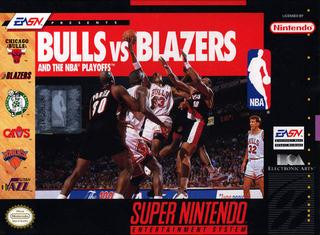
In the early '90s, your favorite team had better make the playoffs or else you wouldn't see them in that year's sports title. As far as the game was concerned, they didn't exist. Also, you wanted to avoid moving around too much with the ball or else you might incur the wrath of the overzealous refs in the form of a charging call.
Developers made incredible strides by the time I tired of playing. I must have quit sometime in the era of the PS2 and Xbox. While I enjoyed playing these games, they improved only incrementally each year. This, along with the fact that I no longer followed basketball, pushed me away.
Fast-forward about seven years. I came very close to picking up NBA 2K10 after seeing some stellar reviews. I figured it had been long enough since I played for me to notice some substantial improvements. The $20 price-point on PC also helped. However, I ended up putting that off because of my extensive backlog at the time.
By the time I was ready to buy, 2K had dropped some delicious info on their next game in the series: the cover athlete would be Michael Jordan. My interest in basketball had coincided almost perfectly with Jordan's storied career with the Chicago Bulls. This was no coincidence.
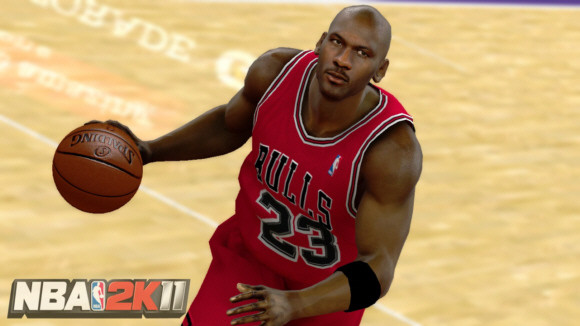
As a result, I decided to stick it out for the next game. I was sure I would enjoy it, and the nostalgic draw of being able to play as Jordan was a great incentive to wait. After all, I had already waited more than half a decade.
I fired up the game and was immediately dumped into the shoes of the man himself — a young Jordan facing off against Magic Johnson and the Lakers. I listened to the commentary as the game began. I still count this as the aspect of basketball games most improved in my absence.

As I listened to them recount the events surrounding the game and what was at stake, it occurred to me that I was experiencing something I never had in a sports game before: drama. I was living out a story. The developers wrapped-up this intensity with the rules of basketball and tied it neatly with a nice physics-engine-shaped bow. At that moment, those mechanical improvements helped me to live out this unfolding drama which depicted actual historical events.
It was truly a revelation. I have yet to touch any aspect of the game other than the Jordan Challenges. Why would I want to? I can live out moments that were incredibly important to me when I witnessed them all those years ago. Not to mention I still have yet to complete all the challenges as they are surprisingly difficult. I’m sure that, once I do complete them, I will happily begin my own drama by drafting Jordan into the current league.
You may wonder what makes this any different from playing as your favorite current star in any sports game. In those games, you merely take your team through a fantasy season. That experience may also be enjoyable and certainly has its place, but it lacks one thing that makes the Jordan Challenges unique: context.
For example, one of the challenges is to score at least 55 points against the Knicks. At face value, this challenge is very shallow. The context is introduced by that brilliant and dynamic commentary I mentioned previously.
Before it starts, you can read about the circumstances surrounding that particular game. In different scenarios, you hear that Jordan is playing in his first outing since returning from retirement or the commentators mention articles from local newspapers. This detailed commentary continues throughout the course of the game.
These minor details make the scenarios feel much more real. Much like one of the many random objects littered around the worlds of Bethesda's RPGs, NBA 2K11 has an attention to detail you expect from a game driven by narrative. Fortunately for us, that's what this game is: a sports game driven by narrative.

I recognize much of this could be lost on someone without proper context. For one, if you didn't know these scenarios were based on actual games, the challenges would lose weight. The reason they are so dramatic is that they really happened! Each of those games -- and countless others -- are tiny little stories of triumph over adversity. These stories, when taken as a whole, make up a career whose equal is not yet on the horizon and one that no player will eclipse for years to come.
Almost every aspect of NBA 2K11 is stellar from the quick response to the deft transitional animations, but that's not the real draw of the game. It allows you to experience a level of drama and emotion that digs deep past the typical surface level provided by these games. You won't simply make the buzzer-beater to win the fantasy finals; you will, as Michael Jordan, make the game-winning shot against the Utah Jazz in 1997 to win his sixth and final NBA Championship in his last game as a Chicago Bull. It's specific details such as these that push NBA 2K11 from the starting five to the Hall of Fame.
[Thanks again go out to Bryan Harper for his help editing this piece.]