What defines a games journalist?

Me
Friday, December 17, 2010
EDITOR'S NOTEfrom Brett Bates

Dennis follows up his incisive portrait of Gerard Williams, aka The HipHopGamer, with an examination of whether Williams represents journalism or entertainment -- and why that distinction is important.
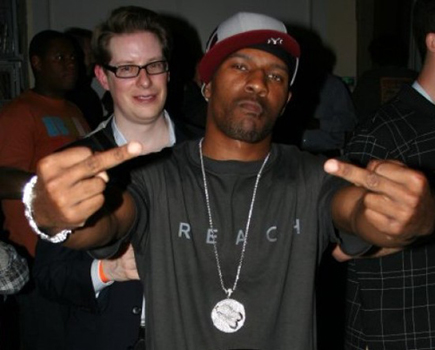
Gerard Williams Flips Off The World

Last week I profiled Gerard Williams, aka The HipHopGamer, a member of the amateur video-game media who has garnered an appreciable amount of press access to events in the past three years. Some journalists think he's a passionate and genuine guy with every right to work alongside the professional video-game media. Others think he's loud, obnoxious, and rude, threatening to beat someone up at an E3 conference this year, and generally being disruptive to their work.

I have no reason not to like Williams personally, but in terms of his work, I think he is decidedly not a journalist by any stretch of the imagination. I could offer up some of the common criticisms of his work like misleading headlines, unprofessional interviews, deliberate attempts at starting flame wars, and a complete lack of bias neutrality. I could look at the fact that by also admitting last week that he only reviews the games he likes, his value as a credible reviewer is nonexistent. Most damningly, I could point out that he openly admitted to plagiarizing content in my interviews with him.

However, the claims that Williams' antics somehow denigrate the whole of video-game journalism are ridiculous. Williams is a hype man, an entertainer. If you're not a journalist yourself, you can't tarnish journalism.

And yet the fact that the charge is even levied illustrates the basis for real concern. Wiliams threatens to injure the reputation of the amateur media and further obfuscate the already murky perception as to what constitutes a credible video-game journalist.


I recently spoke with Gamasutra News Editor Leigh Alexander about fanboy enthusiasts who get press passes for industry events. “The main problem with fanboy or enthusiast writing is, I think, that it takes some experience to learn how to differentiate between one's own taste and what's relevant to a broader audience," she said. "To learn enough about game design to say ‘this is good design’ even if it's not your taste; to learn how to differentiate between ‘I am really excited about this event’ versus ‘this event has a high degree of industry relevance’, etc.

”So when someone who's primarily just excited to be at E3 and 'have a shot' at a games journalism career is getting the same access and opportunities as people who have that experience thanks to covering the industry as their full-time employment, the result is that audiences may not be able to decide whose is an educated perspective or not.”

In his most recent Edge column, N’Gai Croal pointed out that amateur video-game journalism is not all bad. "I prefer to focus on the best of the Internet rather than the worst," he wrote. "It has enabled other thoughtful, considered, and knowledgeable voices that would never previously have been heard to attract an audience to take game reviewing away from solely a consumer guide function and explore games from as varied a perspective as other media." I see this "citizen journalism" as an essential process of garnering a wider audience for the legitimate discussion of video games, similar to what happened with film when journals like Cahiers du Cinema began publishing.

Whether or not amateur games journalism helps accomplish this depends entirely on the quality of the voices. As one of the most visible representatives of this group, Williams can wrongly be viewed as a symbol of an overall lack of quality in the amateur press. And when the audience doesn't understand the difference between video personalities like Williams and actual journalists, the end result may be a retardation of this process of adding innovative “citizen voices” to video-game journalism.

“While it's true that not all the pros are perfect -- ours is something of a guerrilla press corps as it is, at least on the consumer-facing side -- we certainly don't need even less-practiced voices competing to be even louder, faster, sloppier, and more sensationalist than we are because their 'lifelong dream' is at stake," Alexander told me.

(I want to emphasize that Alexander, one of Williams' most ardent supporters in the professional world, was not speaking of Williams in particular here or during any of the other quotes in this article, but I can't help but notice that her words describe Williams' work perfectly.)

I admit that as someone who has only just begun to break into professional video-game journalism, that I long to not worry about whether I'll get into all the major E3 conferences every year such that I can report on them, and look forward to building relationships with luminaries of the video-game industry. Williams' brand of controversy and confrontation have opened those doors pretty quickly for him; and yet Williams is stuck on the show floor at E3, where the garish displays feed the annual circus that attracts the attention of the mainstream press. The actual journalism and the truly cool reveals take place in "the other E3": the meeting rooms and private software demos where only the professionals are invited.

In order to break into this world and truly become a professional journalist, Alexander offered this advice: "Everybody has to start somewhere, of course, but there're ways of doing it right. And what you find is that respectful independent writers who comport themselves professionally and produce good, honest content have a lot better chance at earning more of a living and more bylines than rabid, insecure fans arriving on the scene determined to show us all why we're doing it wrong, or something.

"When people ask me about ways to get into games journalism, I always ask them why they want to do it. 'Because I really love games' or 'because I think it'd be an awesome career' are not very good answers. Whether pro or not, the valuable writer wants to be here because they care about the industry, because they have something to say or something to help audiences see and learn. And someone who cares in that way (as opposed to being on some ego trip, or some vendetta to ingratiate themselves even further into the arenas they've used for entertainment) is going to do a good job, or is going to work on learning to do a good job, I think."

I said in last week's column that Williams was a success -- and by his own thinking, he is. I don't believe that "success" is some kind of objective concept we can measure ourselves against. We set our own personal bars, but how we get there matters, and the problem with sensationalist acts like Williams is that eventually people get bored with them. 

At some point, anyone who is serious about breaking into video-game journalism has to decide whether the immediate reward of celebrity is more important than long-term professional respect. I think that the latter will lead to far greater rewards than page-hit mongering will ever provide.


Dennis Scimeca is a freelance writer from Boston, MA. He has written for The Escapist and @Gamer magazine, is currently penning a feature for Gamasutra, and maintains a blog at punchingsnakes.com. Follow him on Twitter: @DennisScimeca. First Person is his weekly column on Bitmob concerned with meta questions around the video-game industry and the journalism that covers it.

 
Problem? Report this post
BITMOB'S SPONSOR
Adsense-placeholder
Comments (11)
Dscn0568_-_copy
December 17, 2010

I like Alexander's advice.

Picture_002
December 17, 2010

I actually tried writing this comment about three or four times and ultimately just to avoid posting a long, possibly unintentionally offensive rant I'll just say I'm less prone to respecting the endless complaining about him finding his own lane and more prone to respecting the people in this sector of the entertainment medium whom are actually busy producing the 40% of content that resembles actual journalism on a level beyond what's comes out of Super Bowl media day.

Chris17
December 17, 2010
Not wanting to be too flippant but I think it would take a major leap to define any of the video game press as 'journalists'.
Me
December 17, 2010

Then you might not be reading the right peoples' work, Chris. Or I could say that your comment is precisely why we need to talk about this issue more. Here's a short list of bona fide journalists in the video game media:

Kyle Orland
Leigh Alexander
Stephen Totilo
AJ Glasser
Brian Crecente
Ben Kuchera
Alexander Sliwinski
Ben Gilbert

That's just rattling some names off the top of my head, but most of the people on that list have journalism degrees, and all of them tend to focus on news production. They may vary in style, but they're all decidedly journalists.

Default_picture
December 17, 2010

Well, I hope that video game journalists are bonafide. I remember a whole bunch of idiots in my university in Long Beach, who published these crappy, insulting articles in a magazine funded by the student union. Don't ask how the hell the union funded these idiots. It's a long story that wouldn't make any sense even if I tried to explain it.

I think most of the best journalists have a good moral judgment over how to properly distinguish fact from fiction and hard news from sensationalism. With all that said. there's always a black sheep in the family. From what I've read, the hip hop gamer is trying to do some sort of 50 Cent mock-up crap. In actual journalism, it's never all about the writer's big ego.

The real concern is whether journalists will respect the video game industry as a beautiful new medium or trashy egotistic gossip. I certainly hope that we'll learn to lean towards the "respect" side of things. At least, that's what I hope will eventually happen.

Chris17
December 18, 2010

Regardless of background (I'm sure many are legit) and quality of writing (high if you look in the right places). Games media to me means enthusiast press, as it does- to my understanding- to a lot of people within that business. Insisting on the journalist label smacks of pretentiousness to me. Is there any really 'hard news' in games?

Default_picture
December 18, 2010


I think people are getting at this the wrong way. From what I am reading in this article and comments, it seems most of this, is fuelled by opinion and feelings. I advice people to remember what actually defines a journalist. I would like to start from this quote from the main article


“I have no reason not to like Williams personally, but in terms of his work, I think he is decidedly not a journalist by any stretch of the imagination. I could offer up some of the common criticisms of his work like misleading headlines, unprofessional interviews, deliberate attempts at starting flame wars, and a complete lack of bias neutrality”.


Is it not true that, A journalist collects and disseminates information about current events, people, trends, and issues and his or her work is acknowledged as journalism. and by claiming that “ The hiphop gamer “ , in terms of his work he is not a journalist by any strench of the imagination. “ it makes no sense.” It is also wise to note that  Reporters are one type of journalist, and I believe this is where you may best describe The hiphop gamer. They create reports as a profession for broadcast or publication in mass media such as newspaperstelevisionradio,magazinesdocumentary film, and the Internet. Reporters find sources for their work, their reports can be either spoken or written, and they are often expected to report in the most objective and unbiased way to serve the public good.


And for someone to go on and say “. I could offer up some of the common criticisms of his work like misleading headlines, unprofessional interviews” and then dismiss them as a journalist is a tad bit to unprofessional. Gerard Williams aka The hiphop gamer ladies and gentleman is a journalists, whether you feel his not or he is. The work he does and the information he brings is all journalism. I am personally not a fan of him but I just don’t think its right to claim someone is not a journalist because of how they act or how there character comes across. Quoted from the main article“. Others think he's loud, obnoxious, and rude, threatening to beat someone up at an E3 conference this year, and generally being disruptive to their work” .So again , how does this not make him a journalist?  I just urge people to look and evaluate there decisions’ before publicly making claims. It just doesn’t look good at all for the editor of the article to make false claims based on opinions and feelings.

“Some journalists think he's a passionate and genuine guy with every right to work alongside the professional video-game media.” And that’s one of the most honest comment I’ve herd coming from people about The hiphop gamer.


Picture_002
December 18, 2010

Chris, not all journalism is hard news. Bear in mind probably half a newspaper is actually hard news and most of the rest of are news features, sports entertainment and life & arts reporting. Soft news. It's still journalism. Those people stiil get honored at just as the front page wth journalism awards.


Moments like Patrick Klepek broke the news of what was going on at Infinity Ward, that's as close to hard news as often usually gets reported. And bear in mind, while most fans like to hide from this fact, video game journalism is business journalism as much as entertainment journalism. I've worked an job that had me dealing with multiple international and Americanl newspapers and you're more likely a story about this industry n the business section than entertainment. For all the griping about people outside the industry not respect gamers and the industry, a lot of people in the community do a real bang-up of of themselves framing wanting to frame the games press as just "enthusiast" and run from people examining it as the billion dollar business that it actually is.

Also, many people in this industry don't demand that. Actually I've witnessed people for whom their careers are mostly built on reviews and previews and that aspect of this part of the media refuse to call themselves journalists. But if you're out doing what Leigh Alexander and many others have been doing in doing investigative work, I think you have the right to be acknowledged as such. There's nothing pretentious about that.

December 18, 2010

People use "enthusiast press" as a pejorative term, but I don't believe it necessarily has to be demeaning. Look at GiantBomb, the majority of what they produce can be categorized as "enthusiast," and I think they are running one of the best sites in games media. I think the key is recognizing when it's okay to be an enthusiast, and when it's time to get some hard journalism done. Due to the nature of the industry, sometimes there's a call for content production (reviews, previews, podcasts, some features), sometimes news writing (Gerstmanngate, Activison/Infinity Ward, professional interviews).

Channel5
December 18, 2010

While I do think the gaming industry benfits from having personalities in the door, I don't think Hip Hop whatever is the go to guy.

Me
December 18, 2010

@ Chris - I think you misunderstand what enthusiast press means. My understanding is that an enthusiast press means the media is produced for enthusiasts of whatever subject we're talking about. That, in and of itself, has nothing to do with whether the content being produced is journalism or not. "Enthusiast press" is a statement about who the audience is, and possibly about who's doing the reporting; but in the latter case, I'd argue that being enthusiast press is not only not a bad thing, but a necessary thing. Do you really think that non-specialists in the mainstream press, who don't play video games, don't understand video games, and don't care about video games could ever properly report on the industry, giving those of us who DO play video games the information we need?

Go read some mainstream news coverage of video games. You'll read statements that are clearly wrong, and so often the writers just come off sounding like squares. It would be really funny if it wasn't sad.

@ Gerren - I blogged about this on punchingsnakes last night, but reviewers, critics, and columnists are also journalists. Roger Ebert is technically a journalist. Dan Savage is technically a journalist. IMHO part of what makes someone a journalist is sticking to facts, and that doesn't just mean reporting on them. It means being fair in analysis. It means not misleading people. Being a journalist is as much about adhereing to a suite of ethics as it is a description of the actual content produced.

@ tate - You also demonstrate nicely why this conversation is important to have. The one thing you don't address is plagiarism. No credible journalist commits that sin, in part I think because journalists understand that the written word is their product. It's how they earn their living - so they have respect for the work someone else does in producing those words. The second you steal content, you cease to be a journalist, end of story.

I don't know where you get the idea that it's unprofessional for a member of a profession to disqualify someone else from the title if it's appropriate. Is it unprofessional when medical boards yank a doctor's license?

Also, Tate, if you haven't read my column last week, you need to do so. Williams admits to threatening to beat someone up and to stealing content. This isn't hearsay, it's on the record, straight from Williams' mouth.

You must log in to post a comment. Please register if you do not have an account yet.