


Glider was one of my favorite Mac shareware games back in the day, so I have a soft spot for Richard's retrospective on the series.
Imagine a house filled with thousands of rooms, each unique in some small way. Its occupants are mysteriously absent, yet the house is teeming with life.
Goldfish jump in and out of bowls placed haphazardly; a nearby basketball bounces of its own accord. Paper helicopters materialize out of the ether, only to disappear just as suddenly, while two slices of bread hop up and down in a toaster that sits on a small table. Elsewhere, an exposed pipe drips water in a darkened room and balloons magically rise through the floor.
And you are a paper airplane, at the mercy of air currents, whose very survival depends on avoiding these strange and wonderful -- yet simultaneously mundane -- household objects.
This is the world of Glider, a classic Mac game with a devoted fan base that remained strong for over a decade. It spawned from the mind of John Calhoun, who released a simple version of Glider in 1988.
The game evolved considerably over the following decade, growing in depth and complexity, expanding its fan base, adding a level editor, and even picking up a commercial release. This is the story of the origins and evolution of Glider, from its humble beginnings as a mere experiment to the aftermath of Glider Pro -- the final version of the game.
“It may be that I saw games as bridging the artistic and creative pursuits with those more technical,” Calhoun says, when asked about his initial attraction to programming games. His first coding experience came on a Commodore PET computer, on which he modified an ASCII graphics game that vaguely resembled the arcade classics Frogger and Asteroids. A random sequence of asterisks would scroll up the screen, two per horizontal line, while you tried to move your ship (a less-than symbol) across the screen without colliding with an asterisk. He spent time tweaking the game with a friend, making it “richer, more complex, and frankly more fun.” They added shields, enemy ships that would pursue you, and a gradually increasing “asteroid” density.
In later years, he moved on to tinkering with the light-cycle game on his dad’s Commodore VIC-20, whereupon a simple experiment led to the earliest beginnings of the Glider concept. Inspired by the home console version of Choplifter and the well-known arcade game Defender, Calhoun redefined the bitmap tables for the text characters to create something that looked like a blower vent. He also created a triangular, dart-like paper airplane, which could move left or right across the screen. The paper airplane would rise when above the vent and fall at all other times.
Amused by this simple mechanic, Calhoun mentally filed it away -- where it lingered dormant until he entered college some time later.
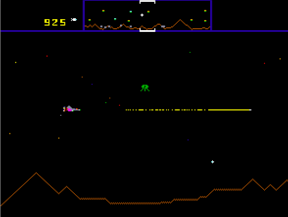
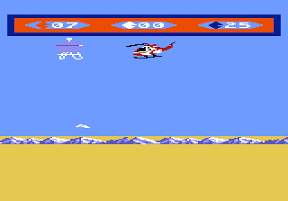
Inspiration for the paper airplane and air vent came from Defender (left) and Choplifter (right)
When asked about the origins of the idea, he suggests that it had something to do with a childhood hobby; Calhoun liked to throw things off the ledge above a large air-conditioning unit at the local mall. The fan on the air conditioner created a powerful updraft, which provided fascinating resistance and lift to the foam peanuts and paper aircraft he tossed out over the unit.
Calhoun picked up his first Macintosh -- a Macintosh Plus -- in college, quickly learning the basics of the Pascal programming language and bitmapped graphics. Once ready to try making a game on his Mac, he decided to return to the paper airplane and blower vent concept. He drew a small paper airplane and an air vent — like one you might see in a house — with MacPaint, a powerful painting and drawing program that came bundled on all Macs at the time. The concept still seemed fun, so Calhoun thought about how it could become a proper game. He expanded the play space, adding tables and shelves as obstacles. The pieces were coming together -- with clever placement of obstacles, the game could be a kind of puzzle or obstacle course for the glider to maneuver through.
Convinced that he had a good idea, Calhoun entered full production on the game. His imagination ran wild, with visions of a series of rooms in a house connected through air ducts and filled with puzzles. New elements were added: Candles could provide additional lift but would burn the glider if you got too close, and electrical outlets might periodically zap. He experimented with physics, trying out different speeds for glider movement, fall, and lift. It was important to work this out early, as a different ratio between horizontal movement speed and gravity would result in the arrangement of objects falling out of balance (giving him more work to do repositioning objects on the screen).
He added objects one at a time, with each meant to fill a role -- be it a particular kind of puzzle or simply for increased variety. Calhoun’s living conditions provided the bulk of the inspiration. Exposed pipes, running from floor to ceiling; ancient rusty radiators; cracks in walls; and hand-me-down furniture were all part of his daily life as a college student in Lawrence, Kansas. If something from his everyday life seemed like a good fit for the game, it would be tried as either an object or decoration. Gradually, Glider emerged more fully as a game with a distinct style and aesthetic.
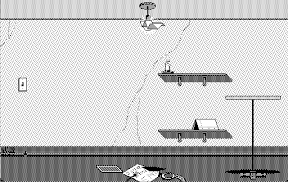
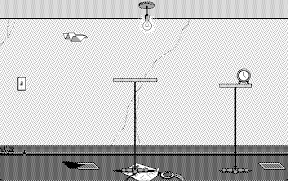
Little changed in the visuals between Glider 2 (left) and Glider 3 (right), but the third installment added sound and a greater sense of polish.
By the time Glider 3 came out, some two years after the first version, Calhoun had a steady stream of shareware checks coming in from people who loved the game -- despite a distinct lack of polish. He had uploaded it to a few of the more popular Macintosh FTP sites, then watched it spread like wildfire.
The money wasn’t much, but it allowed Calhoun to buy a pizza and two large Cokes on a semi-weekly basis. The free pizza helped justify to his girlfriend the frequent late-night programming, while the letters that accompanied the checks gave a little extra motivation to keep improving the game. Referring to the period, he states, “I wasn’t getting rich by any stretch of the imagination, but the letters were often enthusiastic and gave me the sense that Glider was, to some, a special little game.”
Encouraged by the game’s success and inspired by Steven Levy’s book Hackers, Calhoun decided to try getting Glider published commercially. Hackers had captured his imagination with its talk of late-night coding sessions fuelled by caffeine and Dungeons and Dragons. He had planned to become a high-school teacher after graduation, but the book persuaded him to approach some game companies with Glider.
This article was originally published on MacScene and is based on an interview with Glider's creator, John Calhoun, which is available in two parts: part 1 and part 2.