Home
Home

There’s something deceptively seductive about tactical role-playing games: instead of the instant-gratification of combat seen in other genres, tactical RPGs requires patience and careful calculation from the player as they move each of their warriors from one square block to the next. Trying to second-guess your opponent’s moves adds another layer of strategy, as even a slight misstep could spell game over at any moment.
It’s like chess, except if it were invented by an overzealous dungeon master with an eye for detail.
For this reason, games like Final Fantasy Tactics and Tactics Ogre have always topped my all-time favorites list, yet it is a genre that is rarely seen in video games today. Thankfully, Robot Entertainment’s iOS game, Hero Academy, allows me to scratch that tactical itch whenever I want.
Created by the founders of the now-defunct Ensemble Studios -- known for their popular real-time strategy franchise, Age of Empires, and their last console title, Halo Wars -- Hero Academy simplifies the genre by taking out the “RPG” aspect entirely. What you have left is an asynchronous multiplayer-only tactics game that is no less thrilling than its spiritual predecessors.
The only thing you need to know about the light narrative is that the hero academy is a training ground for potential warriors, and the only way they can train is by fighting against each other. Most of the core experience in the game is free: you can play against friends or random strangers as many times as you want, but with only the default human team, known as the Council. The Council includes such fantasy-standbys like a priestess, a mage, an archer and even a ninja. If you want more variety, the Dark Elves and the Dwarves are available for purchase at $1.99 each, both of which introduce new units with their own strengths and weaknesses. From my time playing with these teams, however, neither seemed more overpowered or inferior when compared to the others.
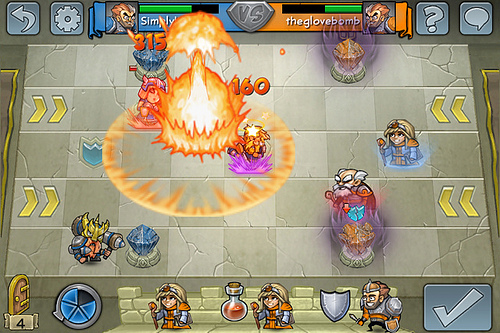
There are two ways to win: destroy your opponent’s crystals, or defeat their entire team. The bar below the battlefield will supply you with units as you need them from a magical revolving door. Additional items, such as the fireball shown above, are rare but they can inflict devastating damage on your opponents, which is especially useful for a last-minute boost of morale.
Certain squares on the field offer power-ups that can aid you as well -- the crystal squares are often the most valuable resource, as they drastically reduce the defense of your opponent's crystals. Other squares can buff up your unit’s offensive and defensive stats, so with careful planning, these squares can mean the difference of keeping your units (and your chances of winning) alive. And with asynchronous multiplayer, players can each take their turns in battle at their own leisure. Some of my games, for instance, have lasted for days, taking my turn whenever I could find the spare time to do so.
The mechanics may seem simple on the surface, but when taking into account the added strategies and units of the extra teams, Hero Academy has lot of depth going for it. Even in defeat, I was constantly striving to learn how to play better by discarding certain tactics I was using in favor of new ones. Not all people play the same, of course, so adapting to their style of play adds yet another wrinkle to a gameplay formula that encourages smart and creative thinking.
It’s rare for a game on my iPhone to keep my attention for longer than a few days, let alone a few weeks, yet Hero Academy continues to entertain me more than a month after I downloaded it. It represents the textbook definition of a perfect portable experience that doesn’t sacrifice depth or gameplay just because it’s a mobile title.
Hero Academy is developed by Robot Entertainment for iOS devices, and it retails for the awesome price of free!