Home
Home

The concepts of what a “video game” all began in the 1940s with an interactive Cathode Ray Tube device, pioneered by Thomas Goldsmith and Estle Ray Mann. It was an analog device that had you, the player, firing missiles at stationary targets on the screen. It was one of the earliest, if not the very first, video game concepts, and it paved the way for a new innovative form of entertainment.
It took a little over twenty years later for a game like Pong to come out, which pioneered the home console market. Ever since then we’ve experienced a fast and rapid advancement in video game technology that can be likened to the Law of Accelerating Returns.
The Law of Accelerating Returns, in a broad sense, is how rapidly technology is accelerating to benefit us as a civilization. Computers become faster, more capable, smaller, more efficient, and more able to think on its own that to a certain point in our civilization we will reach a technological singularity (an event in which technological progress can eclipse human progress) in which human evolution will eventually cease. It is something that seems like it would belong in a sci-fi book, or the storyline of the new Terminator movie, but it is something that many scientists and physicists are studying to this day.

A graph explaining the Sigularity Theory
How does this relate to the world of video games? We can start with Pong, which was the pinnacle game of the early 70s, to now with L.A. Noire, the pinnacle game of our generation at the moment.
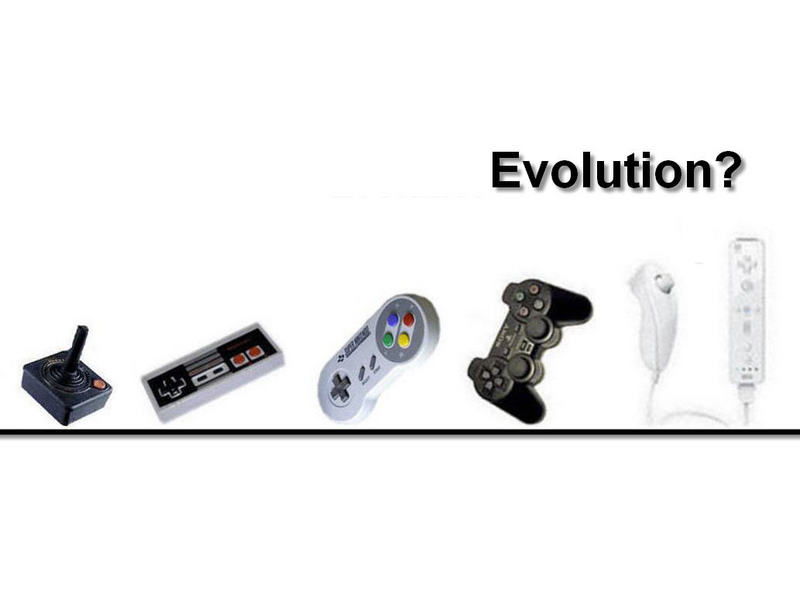
Many experts can divide the evolution of video games in “Generation cycles.” Starting with the first generation, which featured systems like the Odyssey, Atari 2600, etc, home console games were on the rise alongside stand-up video game machines. The stand-ups featured the best play for your money, but the home consoles were really what drove the competitive video game market. That soon came to a crash in the mid-80s when home computers became more and more popular, and video games companies began to develop more for the new world of home PCs. The Nintendo Entertainment System brought the domination of home consoles back into the homes of families worldwide with revolutionary graphics and control schemes, and featured bigger cartridges and better graphics than most PC games at the time.
The dominating home market continued into the next generation with the Super Nintendo and Sega Genesis. Cartridges grew smaller as chip sizes decreased in size and became easier to produce. More complicated controls schemes, more buttons, and larger game lengths started the push for more innovation and more advancement.
With the introduction of CDs on the music market, other companies began to see the benefit of its large memory storage space capabilities, and cheaper production rates. The Sega CD had the right idea, pioneering the CD console generation alongside its PC brethren. However it proved to be too soon, as a lack of great video games for the system, as well as technological and hardware limitations, dominated the market.
The next wave of systems, which came in the early 1990s, the Sony Playstation and Sega Saturn, made the CD video game market the standard. It also began the explosion of 3D gaming, with full and expansive 3D worlds, massive exploration, and the introduction of the analog stick that had you move on what was termed a “Z-axis”. Many at the time thought that CD-based games were the only way that any systems could produce such wonderful graphics; however Nintendo proved them wrong by introducing the Nintendo 64, which featured comparable 3D graphics on a cartridge. This was the explosion the video game world was waiting for, and which began the fast-paced evolution of video games.
Ever since then, with the release of the ever-popular Playstation 2, Gamecube, the dead on arrival Sega Dreamcast, Microsoft’s new venture with the Xbox newer innovations began to surface (online play, the use of larger disc space with DVDs) . The next generation came quickly with the advent of Microsoft’s Xbox 360, Sony’s Playstation 3, and Nintendo’s wildly innovative Wii, which brought the idea of motion controls into the mainstream. Microsoft and Sony followed suit with their own versions of motion controls; the Microsoft Kinect and Sony’s Move.