


As the self-proclaimed indie-game guy at Bitmob, I've been enjoying weird and wild mutiplayer modes since I got into off-the-beaten-track titles a few years ago. Because of this, I couldn't be a bigger fan of Ben's article. Titles like SpyParty, Monaco, Minecraft, and Sleep Is Death are what really excite me when it comes to expanding the horizons of how we create experiences together as gamers across the globe.

In a recent article on Bitmob, Rus McLaughlin argued that multiplayer is in dire need of fixing. He examined three upcoming titles' approach to tackling the problem: Medal of Honor, Dead Space 2, and Homefront. My brief summary of his analysis goes as follows: Medal of Honor attempts to clone Modern Warfare (as the existing de facto standard), Dead Space 2 is a variation on the Left 4 Dead formula, and Homefront attempts to fix some of gamers' most common gripes within the existing multiplayer paradigm.
Rus certainly sold me on Homefront. Developers should have stamped out spawn camping years ago, and I’m all in favor of anything that enables a less-skilled player to hold their own against the super-hardcore, clinically addicted contingent. I’m already fairly confident that I’ll be getting a copy.
But in the context of Rus' article -- that we should hope to “fix the problems driving people away from online gaming” -- Homefront's various innovations amount to little more than tinkering. For my part, Rus didn't go far enough.
Developers need to look beyond simply refining current multiplayer games. It's the core concepts that we need to revisit and move forward. At present, games like Modern Warfare amount to muscle-memory and map-learning skills and an appreciation of the differences between gun models. Don't get me wrong, I love Modern Warfare, but games like it are a lot like driving a car: Once you know what you're doing, you only consciously reflect on your actions in unusual situations. The rest of the time you're on autopilot.
This brings me to my argument about how competitive multiplayer should develop -- if I had my way: It's time to make players think...you know, actually think. I have a couple of games in mind that look to spearhead my “thinking-gamer” campaign.
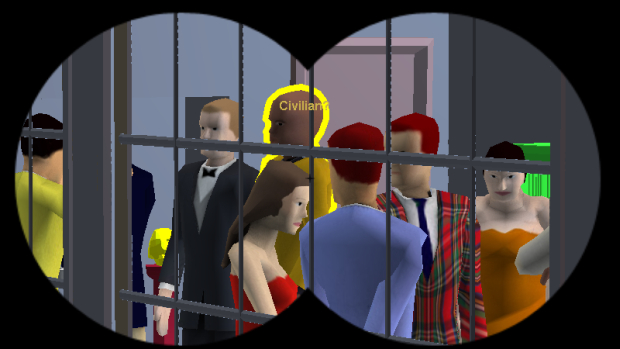
I'll start with SpyParty. If it has somehow passed you by, here’s a brief overview: One player mingles at a party and subtly carries out some naughty bits of subterfuge or wetwork. Meanwhile, the other participant watches through their sniper sight, with the objective of distinguishing the spy from the non-player partygoers and assassinating him.
I can’t imagine playing either role and not giving the game my full, conscious attention. It sounds utterly remarkable, and if it delivers, it will raise the bar of what we should expect from a multiplayer experience.
But of course, it’s much easier for an independent developer to break the mold. What’s needed for the big boys to try and get the average gamer thinking?
It's exactly what the folks at Ubisoft are doing. I can barely contain my excitement for what I’ve read about the forthcoming title Assassin’s Creed: Brotherhood's multiplayer. Again, a short summary of the "Wanted" mode, for those who haven’t heard: Six players must surrepititously execute one of the other assassins. As you stalk your prey, someone else is stalking you -- in a chain -- and you don’t know who they are or where they are. In the usual Assassin’s Creed style, you can blend in with non-player characters to make exposure more difficult.
This is true innovation. I think it’ll keep us alert and focused, and most importantly, it’ll keep us thinking. I'd also point out that it sounds like a whole lot of fun.
In my more cynical moments, I would summarize what I'm saying as a need to move past the current paradigm of competitive multiplayer, which seems to exist as a forum for aggressive, misanthropic teens. My more reasoned argument would be that we need to expand the multiplayer environment to account for more sophisticated tastes. While I am in no way advocating the wholesale replacement of the current style of multiplayer in the shooter genre, I can’t help but feel that we’re in desperate need of some new ideas. The world has room for both, and variety is refreshing!
In many ways, what I'm suggesting would amounts to little more than pulling up the intellectual standard of multiplayer to the level that many single-player campaigns already achieve. I would add that developing multiplayer with single-player purists in mind can only increase the dynamism of the market and the medium: It could be a boon for gaming as a whole.
In the end, instead of operating online as mechanically dexterous automatons, we should strive for a thoughtful, "thinking-gamer" approach.