


This review is divided into parts for the purpose of preserving those precious eyes you intend to use during your twenty-four hour gaming binges. You can choose whether to learn about my thoughts on the flavorful series that is Halo, ODST's vanilla campaign, its fruity multiplayer concoction, or all of the above. Whatever you do, do not mix the three. Enjoy.
A Backwards Glance At The Halo Series
If you've played any video games over the past decade, you may have heard of a relatively unknown sci-fi series called Halo. I mean, it only sold like twenty million copies or something. Who am I kidding--we all know of the series starring Master Chief that has spawned numerous sequels, spinoffs, and web shows such as Red Vs. Blue. Despite boasting three First-Person Shooters and an RTS, Halo is still a crowd pleaser. But there are also those that are not so happy with the direction Halo has taken.
Ever since the 2004 release of Halo 2, there has been an outspoken group of fans who believes that any title released after Halo: Combat Evolved is the devil incarnate. Some may call these original Halo fans irrational, but there's no denying that there's some validity to their claims. Sure, these folks may be a little too obsessed with the original Halo's zooming pistol, but it's hard to argue with their claim that Halo has evolved little in its most recent incarnations.
With three main Halo titles that each have their own dedicated fan base, I think it's worth describing what type of Halo fan I am before reviewing the newest game in the series: Halo 3: ODST.
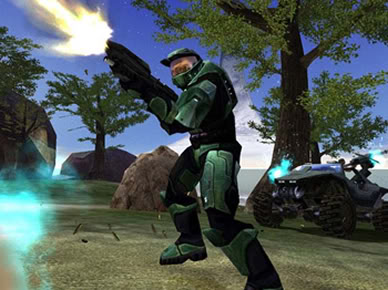
My first Halo experience was with Halo: Combat Evolved, and I loved it. I appreciated the fact that I could only carry two weapons at a time, use dual analog control, and commandeer vehicles capable of carrying more than one person. Halo's campaign was a blast due to its unique weapons such as the Needler, its intelligent enemies who'd actively seek cover, and because of its interesting storyline involving aliens hell-bent on reviving a weapon called Halo for the purpose of wiping out humanity.
An enjoyable campaign wasn't the only part of Halo that thrilled me--I also loved its hectic multiplayer matches that could feature up to 16 players. LAN parties were what Halo was all about, and they continued for years up until the release of Halo 2.
By 2004, Combat Evolved was still my favorite First-Person Shooter, but it would soon be eclipsed by its sequel notorious for featuring a cliff-hanger ending. I really didn't mind being left hanging, because I was happy to play a campaign with fewer glitches and less back-tracking. But what I really enjoyed about Halo 2 was its multiplayer.
Halo 2 was one of my first online console experiences, and it quickly grew into my favorite multiplayer game . I appreciated all of the changes that were made: the ability to able to jack vehicles, dual wield, and use a beam sword. These changes were made even better by Halo 2's innovative multiplayer maps that allowed you to use nearly all of the vehicles that were in its single-player campaign, online--in 16-player matches. I'd never had so much fun--I loved plowing through people with the ghost, arching shots with the Wraith at just the right angle to penetrate a hole in an enemy base, and flying to out-of-reach spots with the Banshee.
None of this vehicular mayhem would have been possible without Halo 2's wonderful level design. Nearly every course was an expertly crafted work of art that included numerous switches, hidden passages, and routes perfect for Capture The Flag and Assault. Unfortunately, the multiplayer levels found in its successor weren't nearly as exciting.
Halo 3 may have had a more balanced approach when it came to weaponry by eliminating many of the advantages provided by the energy sword and rocket launcher, but its multiplayer courses (at least the initial ones) were generally a bore. The Big Team Battle maps felt uninspired, and didn't feel right when it came to objective games. On certain maps, one side seemed to have a distinct advantage, and maps like Valhalla with its uneven terrain and relatively few routes weren't as fun to ride through as a map like Coagulation or Headlong. Still, Bungie did make amends (to some degree anyway) with its downloadable maps.
The multiplayer modes found in Halo 3 may have been underwhelming (keep in mind that my three years of playing Halo 2 may have dampened my enthusiasm for the game), but the single-player campaign was a drastic improvement. The visuals weren't that impressive when compared with contemporary titles like Gears of War, but for once, the campaign felt cohesive. Halo 3 managed to tie up several loose ends, and the enjoyable missions made clear that Bungie had perfected the Halo formula.
Even though Halo 3's gameplay was the most balanced of the series, by the end, it felt like Bungie had ran out of steam. Some indicators of this were Halo 3's minimal visual improvement, a lack of new enemies, and one of the game's biggest new features being a video editing mode. Even more disappointing was the lack of improvements that should have been included such as allowing players to join online custom games from a list.
As you can probably tell, Halo 3 came off as a major disappointment to me, so I wasn't eagerly anticipating the release of its expansion titled, Halo 3: ODST. Still, I was a bit curious to see how Orbital Drop Shock Troopers would turn out, so I struck a deal with my brother who was kind enough to let me borrow his copy.
It's Time To Drop Into The ODST Campaign
Whenever I purchase a Halo game, the first thing I do is play through the campaign, so I couldn't break tradition with ODST. I was worried that this adventure lacking Master Chief wouldn't turn out well, but I decided to quash those negative thoughts and give the rookie a shot.
As with Master Chief, ODST's rookie is the silent, strong type, but this time he doesn't have super-human abilities. The rookie's health doesn't recharge as fast, he can't make Mario-esque leaps, and his vision is clouded in murky red when a bullet manages to penetrate his thick armor. This military recruit also can't dual wield and aim as fast as the chief, so he has to be careful when entering combat situations.
Fortunately, the rookie has some new gear to make up for his weaknesses. He comes equipped with a zooming pistol (that Halo fans have cried out for ever since the original) and a submachine gun that has wild recoil, but is deadly in close-quarters combat situations (partly due to its short-range zooming capability). The pistol packin' ODST also comes equipped with a visor that allows him to analyze mission situations and see in the dark. The phrase 'silent but deadly' would be a perfect way to describe this shock trooper.
The rookie's first mission is to investigate what happened to various crew members after they dropped towards Earth, which was under assault by the always-angry Covenant. After exiting your escape pod, you're tasked with navigating the enormous city of New Mombasa, which was briefly featured in Halo 2. This mission takes place concurrently with the chief's mission, but you won't find him or his sexy AI sidekick anywhere in this adventure. Instead, you'll have to rely on your own wit (and the city's central computer to make it through alive).
The artificial intelligence governing the city will help you navigate by pointing you towards your current destination on your visor. There are no blue arrows to guide you as in Dead Space, but the included compass and kilometer reading gets the job done. It's a good thing this system was included, because New Mombasa is shrouded in darkness and is as plain as a white wall. The repetitive city environment makes it easy to get lost, so you'll want to pay attention to the AI's directions at all times.
It's a shame that New Mombasa isn't much to look at, and this is in part due to Halo 3's visual engine. There just isn't much artistry and technical prowess behind the locales in this game, so it almost feels as if you're looking at a last generation title. The added lighting effects help spruce up Halo a bit, but you still won't find visuals as atmospheric as those of Bioshock or Gears of War. Still, this isn't a major issue, because ODST still features Halo's signature chaotic battles.
As you're wandering through the African city of New Mombasa, you'll encounter three things: the remains of dead ODSTs, Covenant troops, and audio recordings left behind by citizens of the metropolis. ODST remains are the most important discoveries you'll make, because they initiate the game's missions. As you get closer to an object left behind by an ODST, you'll hear an increasingly louder pulsing sound, so you'll know when you've found it. Once you touch one of these sometimes elusive objects, you'll enter a flashback sequence where you'll carry out a mission of another ODST that was part of your landing crew.
These missions play out similarly to those you'd find in previous Halo games--you wander through linear levels completing various objectives. Some levels will have you looking for certain individuals--others will have you defending building complexes, and others yet will have you escorting VIPs. Really though, those objectives are all for show. You'll mostly be engaging in epic battles as you would in any other Halo game.
For most of the ODST campaign experience, you'll be battling vicious Brutes, gnome-sized Grunts, and those pesky flying bugs you occasionally fought in Halo 2. Elites and prophets are nowhere to be found, so you'll have to make new acquaintances.
As in any other Halo game, you can take your enemies out with standard weapons, or you can hop in a vehicle of your choice and wreak havoc. For the most part, you'll be engaging in standard firefights with weapons like the Pistol, Submachine Gun and the Sniper Rifle, but you can also pick up weapons such as the Needler that you'd find in any other Halo game. Unfortunately, you won't find as much ammo this time, so trigger happy folks will have to conserve their ammunition.
If you play on Normal or Easy, finding ammunition generally won't be much of a problem, but Heroic and Legendary really limit you. When I first booted up ODST, I began on Heroic due to a reviewer's recommendation, but unfortunately, I can only recommend this difficultly level to expert players. I had no trouble plowing through Halo 2 and 3 on Heroic, but the ammunition limitations, slower aiming, and cramped quarters made ODST's battles extremely difficult.
Even during the first mission I had quite a bit of trouble. Part of this, I would account to poor design, because there are simply too many enemies and not enough cover to take out masses of foes without having dead-on aim and an extreme level of patience, but the lack of spare weapons was also a problem. Sure, weapons like plasma pistols were plentiful, but I'd often have to charge into a hailstorm of bullets to get one. After dying numerous times, I decided to suck it up and play on Normal, so I could have an enjoyable experience.
As I expected, Normal didn't give me as much trouble. I still didn't particularly enjoy the first mission and its cramped quarters, but I had some fun with the later levels that had me climbing mountains with Warthogs, sniping enemies from towers, and charging through New Mombasa's underground. The levels certainly weren't revolutionary, but they're perfect for people who wanted more Halo 3.
Even though ODST doesn't provide much new other than slightly-altered abilities and the need to seek out med packs, it did make one other major change--the addition of dark, moody environments.
As you first enter New Mombasa (and many of ODST's other levels), you'll notice that everything around you is shrouded in darkness. Your visor negates this effect to some degree by allowing you to easily discover your opponents. The visor highlights them in red, so as long as you keep night vision on, you'll rarely be taken by surprise.
If the enemies somehow manage to ambush you, you'll find that your life quickly depletes, so it's important to keep an eye out for nearby med kits. Sometimes, they're difficult to locate, so it's smart to find one before a battle begins, just in case. Your health does recharge to some degree, so you won't always need to rely on med kits, but it'll never fully recover unless you grab one.
Unfortunately, the darkness doesn't do much else besides provide for slightly more interesting firefights. I expected that it'd create an eerie atmosphere, but it really doesn't. Part of this is due to the story itself, but I didn't feel any emotion walking around ODST's city. Instead, I felt like a cold assassin droid who was needlessly killing Covenant forces.
Unlike previous Halo stories, I couldn't get into this so-called narrative. Maybe it was the poor voice acting and the ridiculous sexual innuendos between the female captain and the ODSTs, but I just couldn't care about the fate of these soldiers. The plot seemed like a poor imitation of previous games in the series, and really did nothing to expand the Halo mythos. Basically, the story just served as an excuse to drive the gameplay, which is similar to what you'd find in archaic NES RPGs.
Fortunately, Halo 3: ODST's campaign got something right--it has a wonderful soundtrack that partly makes up for its uninteresting story and its botched execution. ODST features some beautiful musical themes that range from intense battle pieces to tragic songs. Most of ODST's excellent tunes are all new, so the music is certainly one of the best aspects of the campaign. Unfortunately, Bungie's designers chose to feature many of the songs at the wrong moments.
Tragic songs would begin playing at the wrong times, so what was meant to be sad ended up lending little emotion to the experience. I found numerous incidents where this occurred, so it made the story sequences quite awkward. It's a shame that such a wonderful soundtrack was butchered in this manner.
But Wait, Let's Not Forget The Multiplayer
Even though the campaign ended up being a disappointment that I couldn't recommend to anyone other than Halo 1 pistol lovers and devout Bungie followers, the multiplayer portions more than made up for it. My feelings of disappointment resulting from the mediocre campaign disappeared immediately after popping in ODST's multiplayer disc. This second disc includes all 24 of Halo 3's multiplayer maps--including three new ones that only come with ODST. You can't play these maps as an ODST, but you will find the same great multiplayer found in Halo 3.
It's a shame that Bungie isn't offering some sort of discount on ODST for folks like myself who already downloaded all of Halo 3's maps, but regardless, this package can't be beat. At first, I was a little disappointed that one of the new multiplayer maps was basically a high definition version of Halo 2's Midship, but once I started playing, I couldn't stop. Heretic reminded me how well-designed Halo 2's maps were, so it was nice to experience such a high-quality map with more balanced weapons.
I also enjoyed the other two maps: Citadel and Longshore. Citadel is a small map featuring Halo 3 campaign-level architecture that is meant for 2-6 players. Its symmetrical nature and great weapon placement makes for some fun, but chaotic Slayer matches.
Citadel was fun, but the map I enjoyed most was Longshore. Longshore is an asymmetric map that is perfect for Capture The Flag. This intricately designed map features a high bridge that is useful for quickly accessing the enemy's base, but the switch that opens it is difficult to access. Part of the fun is in finding this switch, but there are many other routes to access the enemy's base. The weapons and ghosts are also in great locations, so it's fun to see players race for these hot ticket items.
Clearly, ODST already has a lot going for it in the multiplayer department with 24 maps, but what really surprised me was Firefight mode. I'd played Gears of War 2's Horde mode, so I thought that ODST's cooperative monster hunting experience would be old hat, but boy, was I wrong.
Unfortunately, I had a bit of trouble finding a match, as you have to have people on your friends list playing ODST to play Firefight cooperatively, but once I found a willing participant, I had a great time.
Before staring a match, I noticed that you could play solo or invite three other players (including local teammates), choose from four difficulty settings, and pick from ten different maps. Immediately, I realized that all these options would provide plenty of an incentive for players to come back, but I had to experience a match first to determine Firefight's potential longevity.
My teammate and I entered a match on "Normal" on the top listed map, and we immediately found ourselves in an eerily silent arena. We had time to check our inventory--a zooming pistol and a submachine gun, and had a moment to briefly examine our surroundings, but we were soon interrupted. Massive Covenant ships quickly dropped off entire squadrons of enemies that we'd have to resist. Little did they know, they were soon to become cannon fodder.
The initial enemies we encountered were typically Grunts and shield-toting Jackals, but as we laid waste to the horde, we'd fight increasingly hard enemies such as Brute Chieftains wielding Gravity Hammers and the ever-deadly Hunters. To make matters worse, our enemies would eventually shower us with grenades. Oh, and did I mention that we came under fire from massive drop ships and Wraiths?
You'd think that Firefight wouldn't be much different from playing the campaign mode cooperatively, but you'd be wrong. What makes this mode special is the coordination that is involved, the limited live stock, and the competition that ensues between teammates. To survive against hordes of enemies for seemingly endless periods of time, players have to know when to pick off opponents with the pistol, and when to charge in together to attack with their submachine guns and rifle butts.
Players also have to pay attention to their team's stock of lives, because once the team's lives are gone, the game ends. If you can make it through an enemy wave with at least one person alive, you'll gain some more lives and ammunition for the next battle, so it's important to do everything in your power to hang in there. This means that players will occasionally need to seek out med packs to restore their health, and they'll need to keep a constant supply of ammo.
The best part about firefight though is the thrill of competing while working together. See, whenever you kill an enemy, you're assigned a certain number of points. For example, you might get 45 points for Killing a Grunt. If you kill another Grunt a minute later, you'll get the same number of points. However, if you take out foes quickly in succession, you'll find yourself amassing points because of the combo you unknowingly performed.
You can soon find yourself getting combos of 1000 or more if you're a skilled marksman, and you'll also hear feats you've performed yelled out such as Overkill or Killtacular. This experience is a rush, and you'll likely never get tired of playing Firefight with buddies on ODST's ten well-designed courses taken from the best segments of the campaign.
As fun as Firefight is, it's hard to believe that we've been playing Halo for nearly a decade. It started off strong, and got progressively better (or worse), depending on what you enjoyed about the franchise. When judging the latest release in the Halo series, Microsoft would like you to remember that ODST is an expansion, but really, I think that's a copout, as this is a full-priced, sixty dollar title. If you don't already own Halo 3 and enjoy the series' sandbox gameplay, ODST is a definite buy, due to the countless hours of multiplayer fun you'll have. However, if you already own Halo 3 and its downloadable content, I'd wait for a price drop, as there's not enough new here to justify a purchase.
To be honest, I'm now tempted to purchase ODST for Firefight alone, but I think I'll wait and compare it to what Bungie's competition has to offer this Fall. If you're sick of Halo, ODST's lazy campaign and questionable design choices won't change your mind, but for a Halo fanatic, it's hard to argue with this incredible multiplayer package. Soldier, your purchasing decision is now up to you.
Score: 8.0
Pros:
- Firefight is a worthy addition to Halo's multiplayer repertoire
- If you don't already own the Halo 3 DLC, 24 multiplayer maps is a great deal
- The Pistol that zooms makes a return!
- The Submachine Gun is a great addition to Halo's arsenal
- The new multiplayer maps are some of the best Halo 3 maps yet
- Features an excellent soundtrack
Cons:
- Unimpressive visuals (the new lighting effects don't cut it)
- Bland city environments lack artistry
- Poor voice acting
- Uninteresting, derivative storyline that makes the player feel no emotion whatsoever
- Wandering around New Mombasa searching for destinations feels like a chore
- Features no memorable characters
- Includes random sexual innuendos that come off as awkward instead of being humorous
- Heroic Mode gives you too little ammo
- Unfortunately, this isn't the revamp the Halo campaign needed
- Where are the new enemies?
- No matchmaking for Firefight mode
- The wonderful soundtrack is spoiled by poor song placement
- Sixty dollars is pricey for an expansion (especially considering that many Halo fans already own most of these maps)