

Separator
Modern Warfare 2 and the Mechanics of Fear
Img950653
Saturday, February 20, 2010

After overcoming the trials and tribulations that are commonly associated with moving (in my case, from Washington, D.C. to Atlanta, GA,) I managed to hunker down in my brand new home and complete Call of Duty: Modern Warfare 2’s single-player campaign mode this week. Now, let me preface this by explaining that I’m far from being a hardcore shooter fan. For starters, I’ve been a console gamer my whole life. My experience with the genre begins in earnest with Goldeneye 007 and Perfect Dark, and I’ve played Halo and other popular shooters with friends as the years have gone by. But the competitive nature of games like these has never appealed to me the way it has to my gaming peers. It’s never been anything other than a social experience.
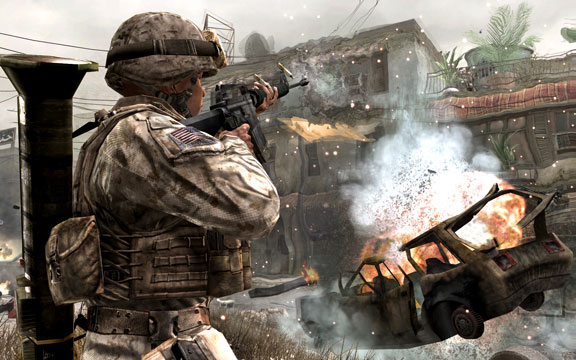
COD:MW2 screenshot

That being said, Modern Warfare 2’s single-player campaign resonated with me the same reason it has with so many others. It’s dramatic, stylish, and takes quite a few risks in terms of narrative and structure in order to keep players interested. (The oft-mentioned “No Russian” level springs to mind, but is far from the only example.) And while the story can be difficult to follow at times, it’s delivered with a blockbuster flair that had me eating it up regardless. Most importantly, it’s fun, and I’ve heard few people argue with that.

But none of the reasons I just listed explain why I really enjoyed it.  In my opinion, Modern Warfare 2 succeeds because – whether its creators are aware of this or not – when it’s at its most dramatic, it manages to do what few other shooters, military themed or otherwise, manage to do: it scares me.

Allow me to clarify. When I say “most dramatic,” I’m not referring to the heavily scripted, quasi-interactive sequences – the slow-mo breaches, the field-clearing explosions, the tension-filled leaps onto helicopters - that I’m sure Infinity Ward considers its pride and joy. It’s clear that the architects of MW2 have found their niche in crafting an “on-rails” experience that is indeed thrilling.

But what I’ve actually found most compelling about Modern Warfare 2 (and to a lesser extent, Call of Duty 4: Modern Warfare and Call of Duty: World at War) is that through its moment-to-moment gameplay, my interaction with the game’s A.I., and even via the game’s controls, I feel as though I’m experiencing the audio/visual/kinetic equivalent of what it’s really like to be a soldier.  As someone who abhors real world violence, this can be unsettling at times. But as a student of game design, it’s incredibly intriguing.

Everyone who’s played the Call of Duty games is probably familiar with what I’m talking about: You take a few careful steps forward. The next thing you know, you’re being swarmed by an onslaught of enemies from all sides. Immediately you rush to the nearest hunk of brick or metal for cover, popping up only for brief periods to quickly take them out. Spend too much time exposed, and risk having a hail of bullets sent your way, eliminating your ability to aim down your sights, and obscuring your view with a translucent, blood red haze. A flash grenade explodes, rendering you momentarily blind and helpless.

It’s in these moments that Modern Warfare 2 shines brightest. All the while, things like quick-time events and a forced, linear progression are working to make sure that everyone who plays the game has a uniform experience, and the most dramatic tension I feel during this game ends up coming from the sequence that the creators of the game had the least amount of control over.

The depravity and futility of armed conflict, the notion that you are but a small, relatively insignificant piece of a larger puzzle – these are the themes I see at work. Not just in Modern Warfare 2’s story line, but in its game design.  

Don’t get me wrong – I don’t mean to poo-poo the developers of Modern Warfare 2 for putting such a remarkable effort into crafting these in-game moments.  I just find it interesting that such no matter how great that effort might be to assure us of the contrary, people are always going to react differently to different things. And it’s that human element – the most unpredictable of factors - that ends up defining my experience.

I realize, however, that some people might have different opinions.  Which leads me to the question: how do you feel dramatic tension unfolds most authentically? Is it through carefully scripted sequences? Or is it organically, via gameplay? Do we tell these stories to ourselves, or do we rely on game designers to tell them for us? I’m curious to hear a variety of perspectives.

 
0
BITMOB'S SPONSOR
Adsense-placeholder
Comments (4)
Lance_darnell
February 19, 2010
I think dramatic tension works best when it is tied into the gameplay. Halo is a good example. Play that game on Legendary and you will have some very tense moments regardless of what is going on in the story. Ninja Gaiden is another example. But then, at the the end of Halo 3 the Warthog ride is scripted and is tense do to the story, yet the gameplay is there. So I would say that the gameplay is fundamental to providing tension.

Nice topic! Hope you are settling down well in your new home.
Eyargh
February 19, 2010
Nice article. I definitely agree. The tension that comes from the fear of dying is definitely the driving (and sometimes most compelling) force in shooters today. The hard part is finding the balance between afraid of that consequence and being annoyed by it.
Default_picture
February 20, 2010
@Paul: Imagine a future game design that not only has enemy AI, but a kind of larger, world-level AI that can change the enemy's group strategy against your FPS avatar on-the-fly, according to hypotheses and observations of your playstyle. Something that Left 4 Dead offers a glimpse of. A game that doesn't rely on the volume of numbers alone, but includes that as well as the capability to try and outthink a human player. And yet a system that manages to always figure out just the right amount of leeway/opening/chances for you to have a little success and struggle forward.

Then, on a replay, having discovered the tactics that got you to the end, and trying to use them again, the game adapts but again leaves just enough openings for you to try with new tactics, strategies.

Which is more terrifying, that a program could eventually be that powerful, that such a program would have to be designed to string you along by teasing you with "fake" opportunities to outsmart it, or that, should a developer put just enough effort into current AI they could just about fake that experience for a large part of the population who might play the game?

And this doesn't even get into story, or graphics, or anything else outside the interactive guts of the thing.

Then again, I can't help but think of playing against chess AI. I don't think it's either a game or interactive experience that most people would play for long, but I wonder how little dressing up it would take to have those chess AI guts driving gameplay that essentially has to handicap itself to give you a sporting chance.

Heck, sometimes that's how I feel playing 4X civilization games.

Personally, I don't think it's a fear of dying that comes into the experience of suspense; it's that suspicion, that self-doubt, that you are capable of overcoming an obstacle that a designer has challenged you, personally, with. Then I think to myself, "But surely this was playtested! Others have surpassed this! Why am I failing?!"

They are pits of inadequacy, that, thank the gods, I can usually overcome, bursts of reward that gets me through to the next challenge and the one after that. If I use the game as laid out, then it's a clean win, and if I feel like I used or might have used an exploit or played with the "boundary" of the game engine/AI, it's still a win, but a hollower one where I ask if that's how it should have been done.

That latter way of overcoming obstacles nag me the longest, wondering if I could have done "better", or if that was a legitimate method the developers recognized. It's a feeling that I think resonate ever slightly with the thoughts of Truman on demonstrating the power of the nuclear bomb. "Is there a conventional way to defeat the enemy? Are we good enough? Is it worth it?"

Or if that was too harsh an example to liken the experience to, I refer to the book Ender's Game. Whenever you play a game you almost always know that there's nothing really serious about it, that the worst you lose is time and money, and maybe some sanity if you played a really really horrible game (damn you StarFox Adventures, I thought you'd get better after every level, but always disappointed!).

The real suspense comes from implicitly knowing that this game is winnable (or else why would it sell?), but not knowing if you are good enough to win.

Ever play a roguelike? Now *those* are scary. Game mechanics-wise at least.

Heck, I had to stop Resident Evil because the atmosphere was downright creepy. So I'm not saying that other parts of the game can't be scary too, but cinema got like 40 years head start, and other media much more than that, to learn to be scary.

So I focus on scary game mechanic design, figuring out how to do the equivalent of pimp-slapping a player's face and throwing down the gauntlet while everyone that matters to them bear witness, and yet providing this same player with sporting chances to beat novel and creative challenges, and doing that throughout the entire game while goading the player into coming back for more. That reminds me, I eventually need to get me a PS3 so I can play Demon's Souls.
Img950653
February 25, 2010


@Jonathan - I don't think the type of A.I. you're describing isn't very far off, as far as the world of competive FPSs goes. Like you said, so many of those elements are prevalent in the way the Left 4 Dead works. I think Valve would do well to continue working with A.I. direction, and seeing where they can take it.


I find the way that you described your tribulations with conquering difficult parts of a game very different from my own. Unlike you, I seem to be unable or unwilling to tell myself "this is just a game, etc." when I'm in the moment, the relative importance of conquering a game doesn't register on anything other than a guttural, sensory level. 


Fascinating!


You must log in to post a comment. Please register or Connect with Facebook if you do not have an account yet.