


Playing the excellent Valkyria Chronicles again recently, I really enjoy the stylized, "watercolor painting in motion" look of the graphics. But that game released about three years ago, and the march toward realism continues on. And with 3D on the horizon, will we truly see more developers express their visuals in unique ways, as Hatuey suggests? I sure hope so.
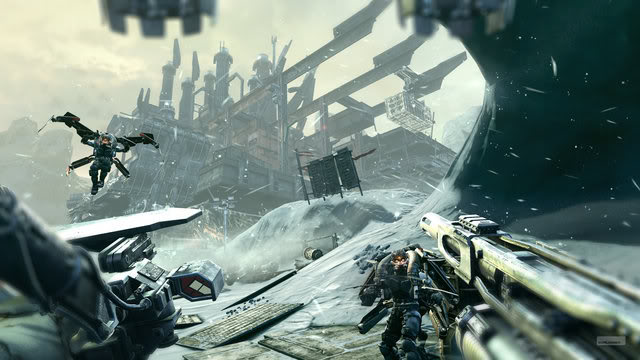
Damn, dude. Killzone 3 looks good. I mean, dude, just check out that hangnail on that dude's hand!
Did you not hear me?! You. Can. See. The. Friggin'. Hangnail. Man!
Wait, what the fuck? Did I really just spend 10 minutes staring at a hangnail? (More disturbingly, did somebody spend countless hours rendering a hangnail...? Eww.)
As we march across the uncanny valley, a question comes to mind: Is photorealism really all it's cracked up to be? I can't help but feel that as technology advances and we get closer to being able to render things that are indistinguishable from reality, more and more developers will actually veer away from depicting things that way.
See, one of the problems with devoting all your assets to rendering things realistically is that there's a cap to your efforts. After all, where do you go from real? Is there such a thing as realer than real? Is real even what you want? Case in point: X-Men Origins: Wolverine.
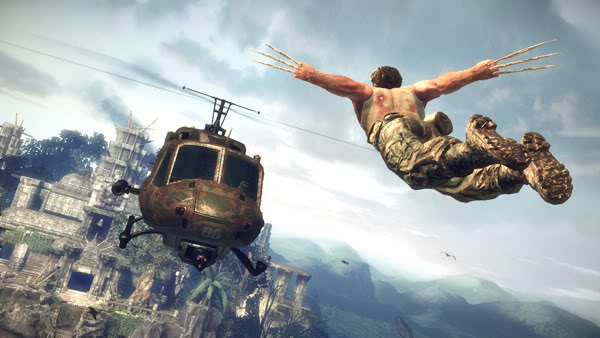
I don't know if anybody bothered to watch the making-of documents in that game, but one of the more interesting ones concerned the modeling of Wolverine himself. Apparently, the developers started by getting a full-body scan of Hugh Jackman (who played the role in the film), but when they placed him in the game, they found the results to be underwhelming. This is the friggin' man himself we're talking about here, and he looked like a wimp! At the end of the day, there was nothing left to do but juice the model up with some digital steroids.
This is actually not uncommon...especially in games that are played in the third person. When the camera is pulled out, proportion and scale are often exaggerated in order to make things read clearly and dynamically. This is the same reason all the dudes in Gears of War look like mutant linebackers and why you'd probably be kind of freaked out if you were to ever see Kratos in real life.
Sometimes, developers stray from realistic depictions not out of practical needs but of wanting distance themselves from the rest of the pack. A perfect example of this would be Borderlands.
Initially, Borderlands was set to look like most other futuristic shooters, but fairly late into development, Gearbox decided to go with a much more cartoony look -- and it paid off. What's interesting about this is that unlike smaller, indie developers who can't afford to make things look photorealistic due to the assets involved, Gearbox had the resources but decided to hold back. It was a bold decision, and one I feel we'll be seeing more often in the years to come.
One of the reasons I feel the next-gen landscape tends to be fairly visually homogenous is that a lot of developers are more concerned with how they depict something as opposed to what they depict. When the technology gets to the point where rendering something in photorealistic fashion isn't a big hurdle anymore, it'll make sense that developers will be more willing to explore populating their worlds with something besides the usual video-game clichés. I mean, really, we can have only so many space marines...or can we?
Oh shit, I think I just pissed off a big pack of space marines...be cool, man. Be. Cool.
Obviously, there are a ton of factors that contribute to why games look the way they do and feature the type of characters they do, and at the end of the day, certain genres just work better when rendered in a certain way. As the technology behind video games advances and gets to the point where developers don't really have to think about it so much anymore, the freedom this will hopefully result in all sorts of interesting and new worlds to explore.
You can already see how these advancements are helping change the gaming development world. Many companies are now looking for people with more traditional backgrounds in the arts since these new programs mimic those classic mediums very closely. These new people coming in tend to have more diverse backgrounds and influences then the usual guys who know only games, and we'll see those influences in what we'll be playing.
Personally, I'd kill to see a game inspired by the work of Winsor McCay, one of the greatest illustrators of the last century.
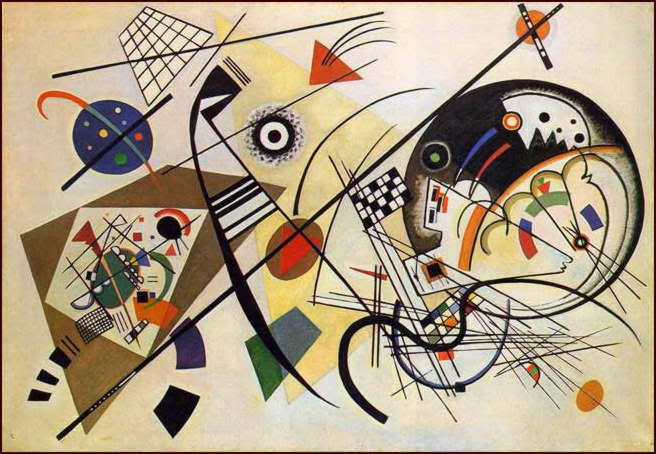
Maybe one day we'll even see a game influenced by the paintings of Wassily Kandinsky, a celebrated abstract painter and theorist. Point and Line to Plane is one of the most important treaties on form with its influence on people...and the type of thing that most guys working in the various art departments in gaming companies probably haven't read but should.
In pushing toward more photorealism in games, I feel the end result will actually be a freedom and inclination toward exploring more abstract and interesting ways to render worlds.