Home
Home

(This article contains story spoilers for Killzone 2 and Killzone 3.)
As a final expression of power, the dying Emperor Scolar Visari ignites a nuclear warhead within the Helghast capital city of Pyrrhus just as Interplanetary Strategic Alliance (ISA) soldiers storm his palace.
Behind a statue depicting two soldiers helping a group of civilians, artillery fire illuminates the sky. The sudden bright light of the atomic detonation washes out these smaller flashes of war; as the blast wave hits the memorial, the image transforms: The soldiers' eyes now glow, and their rifle stocks shift downward toward the family of three in an oppressive manner.
A wall sculpture of a businessman leading a team of miners reacts suddenly to the devastative power now leveling Pyrrhus: The suit's forward-reaching hand melts into a long whip that swings backward over the working-class men.
Finally, burning embers slowly blanket a triumphant painting of Visari; his once celebratory subjects now scream in the silent agony of his despotic, red eyes.
In Guerrilla Games' latest first-person shooter, Killzone 3, such displays of strength are transformative; they are simultaneously empowering and self-defeating. Usurping authority plays a central role in both narrative and gameplay.
Player protagonist Tomas "Sev" Sevchenko and wingman Rico Velasquez express this idea through a power struggle with their superior, Captain Jason Narville. At the conclusion of Killzone 2, Rico murders the Helghast emperor in defiance of direct orders and finds himself on the receiving end of a promised court martial. Narville is adamant that both Sev and Rico follow the ISA leadership's decree, but our two heroes refuse to step in line. Both place stopping the Helghast above their own self-preservation, and they're willing take any risks necessary.
Ultimately, Sev's and Rico's insubordination pays off in big ways; through these interactions, Killzone 3 demonstrates the transformative power of the duo's innate, rebellious attitudes. Once all's said and done, even Narville recognizes the error of his rigid adherence to the chain of command and tags along for the final sequences in the game.
The empowering nature of the protagonist's dereliction of duty is evident in the extensive, aesthetically industrial, military hardware at the player's disposal, which become available only due to Sev's and Rico's refusals to follow orders. A mech-like walker complete with a ravaging minigun and rocket launcher, a jetpack suit with rapid-fire weaponry, a high-speed "Ice Saw" vehicle with heat-seeking missiles and machine gun, and a space fighter equipped with laser blasters and homing missiles are just some of the ways that Killzone 3 puts players into a cockpit of pure destruction. These sequences are brief but satisfying in their ability to provide a sense of dominance over the Helghast forces.
Simultaneously, another struggle with the opposite narrative ramification plays out between Admiral Orlock, who has assumed command of Helghan's forces in the wake of Visari's death, and Jorhan Stahl, CEO of the alien nation's leading weapons manufacturer. Orlock wants to use Stahl's new experimental technology; however, Stahl believes Orlock to be an incompetent fool. Both vie to fill the power vacuum within the Helghast leadership.
But Stahl's insurgence against Orlock's rule is borne from selfishness rather than altruism. After a face-to-face confrontation that leaves the admiral defeated, Orlock argues to Stahl that his coup d'état weakens Helghan. Despite the space battle between the two Helghast factions raging in the background, Stahl still doesn't care; he is intent on using his new weaponry to kill every last human on Earth once his cruisers engage their warp drives. This power schism taking place eventually opens the window for human victory, thus eliminating any chance Stahl may have had to wield control over a nation.
And in contrast to the empowerment experienced through the player's ISA perspective, technology actually becomes the Helghast's Achilles' heel. Stahl's experimental armaments infatuate Orlock, who agrees to give the weapons tycoon wide latitude in confronting the ISA threat. And perhaps ironically, this obsession becomes the undoing of the Helghast people. As Jammer, a female ISA soldier who's assisted Sev and Rico in their insubordination, scans the Helghan surface after the ISA unwittingly redirects the cataclysmic force back onto its creators, she reports complete radio silence.
The surface of Helghan appears lifeless.
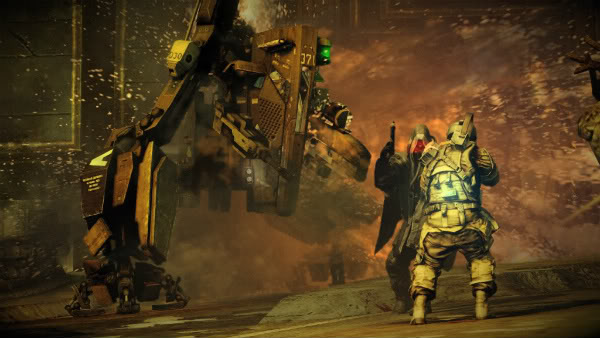
Killzone 3 is a story about power and the contextual meanings of subversion. Just as statues, sculptures, and paintings transformed under a nuclear explosion, the power of defiance alters our primary protagonists and antagonists in functionally opposite ways. Stahl's grasp for control eventually fails because of his own egocentric desires, while Sev and Rico embody an individualist approach to rebellion that ultimately benefits all.
Such thematic cohesion is rare in a narrative-based shooter, and I'm glad to see Guerrilla explore these ideas in interesting -- even if not terribly original -- ways.