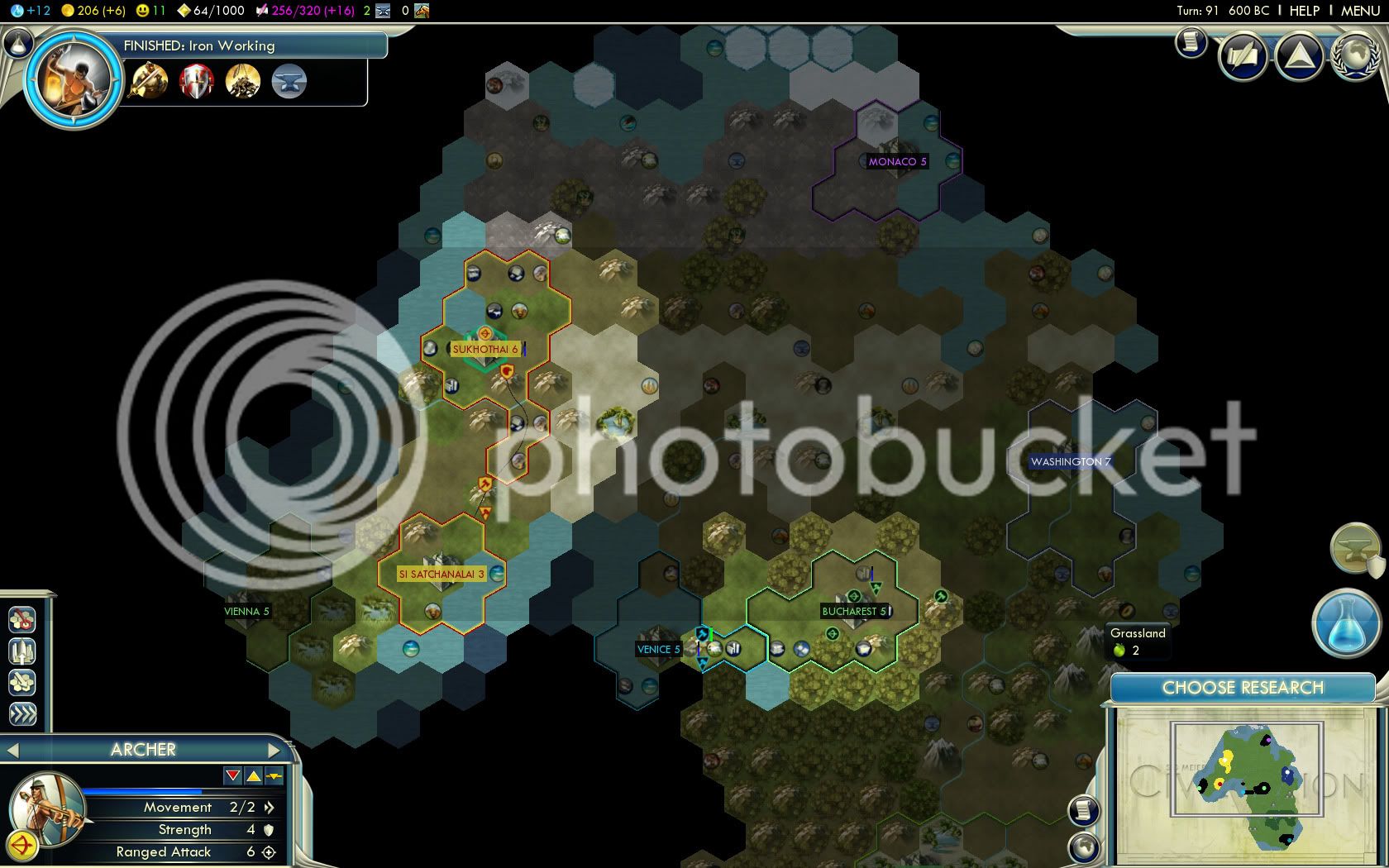


Rob: While James fell into the shadow of Arabia, I cast mine over the rest of the world. My final conquest lies across the ocean just west of America's continent on the largest landmass in my game. The three remaining civilizations live there: China, Persia, and Siam. With happiness still problematic and my treasury completely depleted (units began disbanding on their own!), I had to act. I sent my forces -- two cannons, four samurai, two knights, and two great generals -- to first invade China.
It was a bloodbath. The tactical A.I. just couldn't handle the nuances of the game. China barely put up a fight: They hardly had any military units! In nine short years after my army set sail for conquest in 1904 A.D., Wu Zetian's last city burns to the ground.
With two competing nations remaining, Persia and Siam, I develop a plan to quickly end the game. Each civilization's capital city sits close to Shanghai, China's final city to fall. I go for the one-two punch of targeting Persepolis (Persia) and Sukhothai (Siam) for the win. In Civ 5, I only need to conquer capitals for a domination victory.
Japan poised to capture the last capital city.
In the field, I upgrade my units to riflemen and artillery. The latter proves terribly powerful: These heavy hitters launch ranged attacks from three hexes away, which is outside of a city's bombardment radius. From afar, I quickly bring down these cities' defenses and send in a rifleman for a swift capture.
James: I had no such gilded trumpets heralding my unending victories, and so it is that the noble Ramkhamhaeng finally met his end during the Renaissance. The war started at the very end of the 18th century; to be honest, it didn't last very long. Al-Rashid moved in with superior numbers, although -- I may boast -- not superior firepower.
I tried placating him with resources, money, and eventually cities. But in the end, it was like trying to offer a burglar, who has you at gunpoint, your T.V. just to get him to leave your house. You're in no position to bargain, he's staying as long as he likes, and he's taking what he wants. I do like to think that I was benevolent enough that al-Rashid would view me as an agreeable and pliant leader concerned with my people's welfare. Hopefully, he installed me as a puppet.
It's funny to me that Rob's warpath was so successful. When he and I started this collaboration, the idea of constantly being at war concerned me. I'm less experienced with the series than he is, so I asked him to be the warmonger because I assumed it would be the more difficult of the two modes. I think, in the end, that I was wrong. And as my capital burned, I had an epiphanic moment: Austere pacifism is a path that only veteran players should endeavor, if anyone at all.
Siam's final days.
Rob: Like Genghis Khan, I realized that warmongers need to stay on the move. Each time I stopped to recuperate from war, unhappiness and expenses would strangle my civilization. Earning gold through the conquest of other nations was the only thing stuffing my coffers until I adopted the Autocracy policy branch and built the forbidden palace. The former reduced military upkeep costs, which allowed me to field a larger army, while the latter eliminated some unhappiness due to population. These benefits didn't have such a great effect, as I reached them late in the game.
The tactical A.I. just doesn't cut it, at least on the default difficulty level (prince). In both wars against Washington and Ramkhamhaeng, their military forces far outnumbered mine. Through smart maneuvering and decisive tactical victories (and Bushido!), my smaller army always defeated the larger foe. Civilization 5 just doesn't seem to know how to utilize the myriad options available in combat.
I also enjoyed playing Civ less as a pure warmonger; I wanted to mess about with the city-states, initiate research pacts, or secretly plot against an A.I. player in conjunction with another. Forgoing diplomacy completely was unsatisfying in the end.
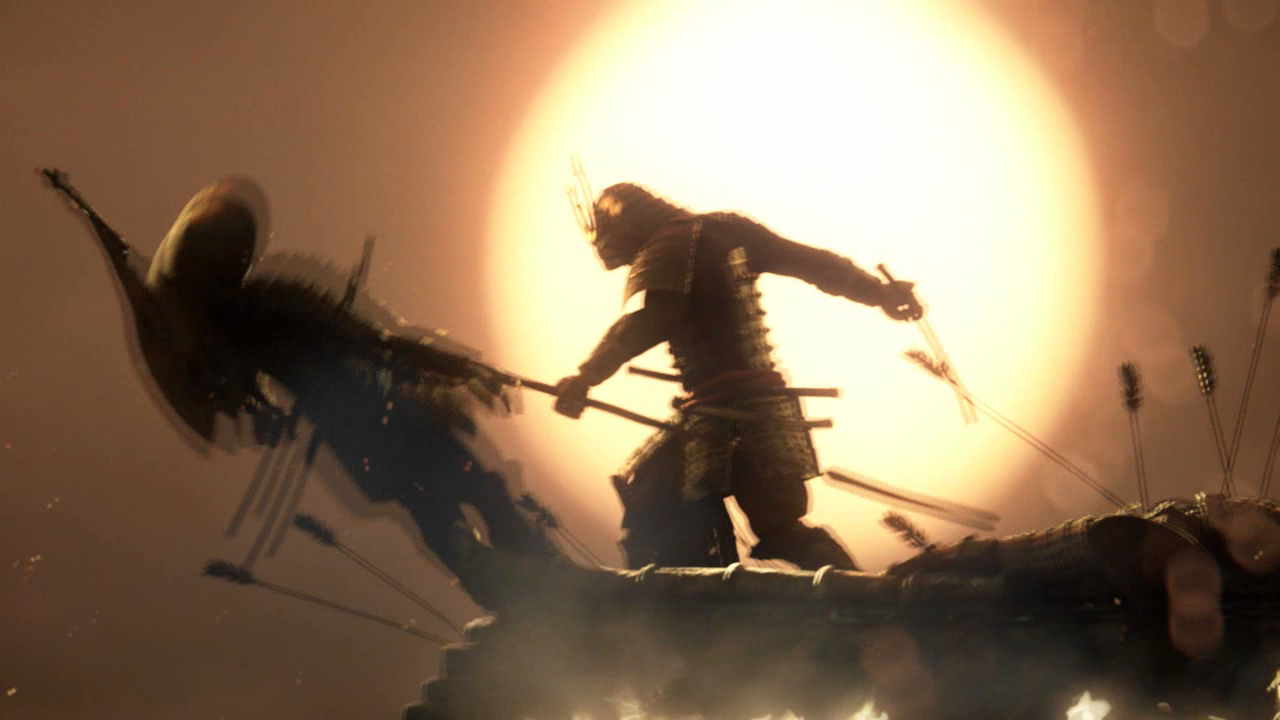
And then we have the victory screen. While series staples such as demographics, rankings based on historical figures, and final scores are present, Civ 5 neglects the start-to-finish replay of your game! That was always one of my favorite features of Civilizations past, and I'm sad to see it missing here.
James: This ain't a pacifist's game. And so, I guess this is the time to point out a shortcoming of the series that my play method really accentuates: Civilization has never really included the option to fill out a mediator role on the world's stage solely because it remains so married to the idea of developing your individual society.
In this installement especially, the easiest way to get what you want is through military might. In another game I've been playing for fun, I brought Napoleon to his knees during a war he started, and in the end, he forked over Lyons and Orleans just for the sake of peace. And let me tell you, the technical aspects of Civilizations 5's overhauled hex-based, single-unit war scenarios really do shine -- even if the sad-sack A.I. is somewhat irksome.
But to date, the series has only really paid lip service to the idea of diplomatic victory. I think it would be cool if the game allowed you to see every society's opinion of every other with the same meter bar that the city-states have. Three-way pacts would be a great addition, too. Think about it: What if you could create trade agreements like NAFTA? They might benefit your relationships with developed countries while eroding your interactions with less-developed, fledgling nations. What if you could ally lesser powers into an embargo effort against another leader?
In the end, though, politics and diplomacy come through much more prosaic means: Build big guns, and point them at the enemy. Any real sense of diplomacy basically amounts to paying off city-states so they like you and focusing your end game on the U.N.
I don't want to say that my loss was totally Firaxis's fault. Indeed, if history is the model we look toward, it seems quite realisitic that pacifism shouldn't be a methodological option until late in the game. After all, how do you reason with barbarians?
I do, though, wish the game had more options for trade agreements, multicultural peace negotiations, and multinational science and culture ventures. Instead, we have only research agreements. Another great addition would be the ability to win an economic victory. It would be neat if you could let other countries remain autonomous, while being able to dominate them through economic social policies that usurp their production and depress their economy. Instead, Civilization 5 remains very focused on indiviual and compartmentalized development of -- just what the box says -- your civilization.
But hey, here's lookin' at you, Civ 6.